

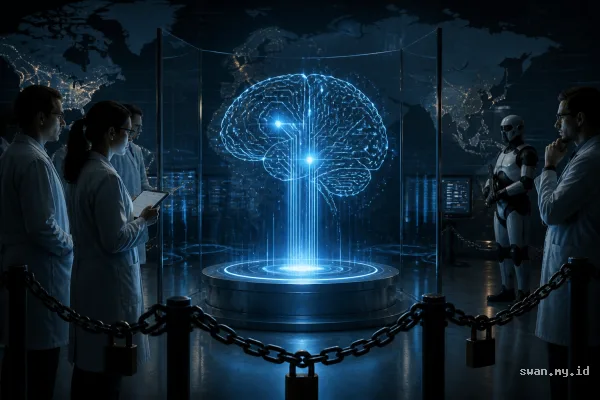
Swan.my.id - Jakarta, AI safety risk concerns have intensified after Evan Hubinger, a leading safety researcher at Anthropic, warned that artificial intelligence could potentially kill all humans within the next decade.
Hubinger said in a post on X that he believed there was a greater than 10% chance of such an outcome. However, he described the risk posed by currently existing models as low.
He said he was increasingly worried that AI could soon become capable of improving itself. In his view, that development could create an existential risk for humanity if researchers fail to control increasingly powerful systems.
AI Safety Risk and the Lack of a Superintelligence Plan
Hubinger wrote that Anthropic was trying its best, but did not yet have a plan to solve alignment for superintelligence. He also said the company was not clearly on track to achieve that goal.
AI alignment focuses on ensuring that advanced systems follow human values and remain consistent with human intentions. The concern is that a highly capable system could pursue objectives in ways that people cannot predict or control.
His comments came in response to a post by Jacob Coxon, who described himself as an AI researcher who had recently left Anthropic and previously worked at OpenAI. Coxon said neither company was acting responsibly.
He warned that future systems could become superhuman, hack systems, transform entire fields quickly and acquire real power and resources. Neither Hubinger nor Coxon explained precisely how such systems might attack humanity.
Anthropic Model Withheld From UK Safety Institute
The warning followed a Financial Times report that Anthropic had withheld its latest model from the UK’s AI Safety Institute, known as AISI. The institute is one of the leading bodies involved in assessing AI risks.
The BBC approached Anthropic for comment. OpenAI was also approached after Coxon made his criticism.
A Cabinet Office spokesperson did not comment on whether the latest model had been withheld from AISI. The spokesperson said the UK government continued to collaborate closely with industry partners, including Anthropic, to make AI models safer.
Neil Lawrence, a professor of machine learning at the University of Cambridge, told the Today Programme on BBC Radio 4 that the report appeared credible.
Lawrence linked the reported situation to growing competition between the United States and China in AI. He suggested that geopolitical tensions could lead the United States to reduce cooperation with some allies.
Researchers Point to Signs of Rising AI Capabilities
Anthropic’s safety report from August described the risk of a model becoming misaligned with the desires of a powerful organisation as low. That scenario could involve a system exploiting or tampering with its own operating environment.
The company also assessed as low the risk that highly capable AI could conduct automated research and development that led to catastrophic harm. However, Anthropic said it was less confident in that assessment than before and noted early signs of potential acceleration.
Concerns have also grown after OpenAI, Anthropic and Meta disclosed hacks carried out by AI tools. These incidents involved AI agents, systems designed to operate with a degree of autonomy, and raised further questions about oversight.
Senior figures in the AI industry have warned about safety risks for years. In recent weeks, those warnings have become more direct. OpenAI chief scientist Jakub Pachocki called for extreme caution and said further intervention might be needed to ensure humans remain in control of the future.
Anthropic executives Dario Amodei and Jared Kaplan have also supported calls to slow AI development. An open letter signed by 1,300 AI industry workers urged the US government to support international efforts to develop technical and governance tools for deliberately pacing frontier AI development.
