

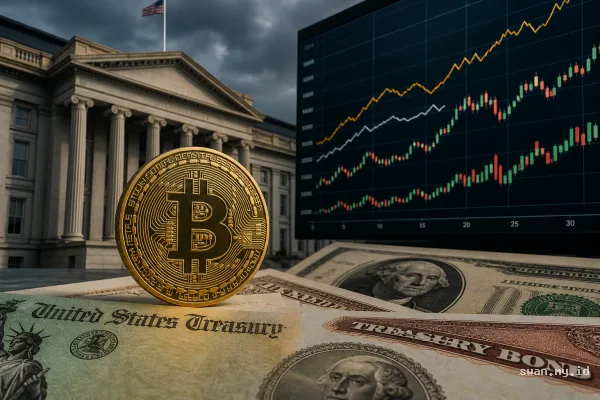
Swan.my.id - Jakarta, the Bitcoin debasement trade is entering a new phase as US federal debt surpasses US$40 trillion, while Bitcoin trades near US$80,000, roughly 37% below last year’s record high.
The situation raises a difficult question for one of Bitcoin’s oldest macroeconomic narratives. If rising debt and weakening fiat currency are supposed to increase the value of scarce assets, why has Bitcoin fallen throughout 2026?
Analysts at BloFin argue that the answer lies in a shift in how investors view the debasement trade. According to the firm’s latest report, the trade has entered a “second phase.” Investors are now watching government efforts to control borrowing costs as closely as they monitor money creation.
The Bitcoin Debasement Trade Lost Momentum Before Recovering
The debasement trade rests on a straightforward idea. Large fiscal deficits eventually create pressure for looser monetary policy because governments cannot allow borrowing costs to rise indefinitely.
Investors may then turn toward scarce assets such as gold and Bitcoin. However, that thesis began to weaken in early 2026. Bitcoin fell below US$62,000, while gold and silver also dropped sharply from their previous highs.
BloFin linked the major decline to the nomination of Kevin Warsh as Federal Reserve chair. The market viewed Warsh as less likely to use aggressive balance-sheet expansion to absorb fiscal pressure.
As a result, the debasement trade became increasingly dependent on expectations. Investors could still see large deficits, but the path toward easier monetary policy appeared less certain.
Bond Market Volatility Changed the Picture
The situation shifted in August. On August 18, the yield on the 30-year US Treasury reached its highest level since 2007.
The following day, the US Treasury Department said it would at least double the maximum size of liquidity-supporting buybacks for 10- to 30-year bonds. The maximum would rise from US$2 billion to at least US$4 billion per operation.
Bitcoin gained about 25% in August, while gold rose approximately 15%. The timing was significant because the buyback expansion followed a sharp increase in long-term bond yields.
That sequence suggested that policymakers might be increasingly reluctant to accept elevated borrowing costs. Therefore, investors began to consider whether rising long-term yields could prompt a policy response.
Treasury Buybacks Are Not Quantitative Easing
The Treasury cannot create money independently. It must fund buybacks with cash, tax receipts, or new borrowing. This makes the mechanism different from quantitative easing conducted by the Federal Reserve.
Under quantitative easing, the Federal Reserve creates reserves and purchases government debt. Treasury buybacks mostly change the composition of government debt rather than directly creating new liquidity.
BloFin nevertheless argues that markets may focus more on the direction of policy than on the immediate liquidity effect. The report emphasizes that “Treasury buybacks are not QE.”
Even so, investors could begin to expect an informal ceiling on borrowing costs if repeated increases in long-term yields trigger official intervention. This is where financial repression becomes part of the broader narrative.
Real Yields Remain a Major Challenge for Bitcoin
Current data shows why the debasement trade remains unfinished. US public debt stands near 101% of gross domestic product, while the 2026 deficit is projected to approach US$1.9 trillion. The M2 money supply indicator has also returned to growth.
At the same time, the real yield on 10-year Treasuries remains around 2.4%. That creates a significant obstacle for Bitcoin because investors can still earn strong inflation-adjusted returns from government bonds without taking cryptocurrency risk.
This dynamic also helps explain why Bitcoin’s 2026 price movement still resembles a traditional crypto cycle. Bitcoin reached its peak about 534 days after the April 2024 halving, which is close to the timing of previous cycle peaks in 2017 and 2021.
After that peak, the price fell by more than half before beginning another recovery. The older four-year cycle therefore remains relevant to the current market structure.
Could Policy Eventually Adjust to Rising Debt Costs?
BloFin’s thesis would gain strength if real yields began to decline while fiscal pressure remained high. That could happen if persistent long-term borrowing costs created enough pressure for a stronger policy response.
A more aggressive possibility would involve the Federal Reserve intervening directly. Historical precedent exists. From 1942 to 1951, the Federal Reserve capped long-term Treasury yields at 2.5% to help the government finance wartime debt. Inflation later pushed real bond returns deeply negative.
Bitcoin would not need an identical scenario to benefit. The asset could gain if investors became more confident that policymakers would eventually protect the government bond market from the burden of rising interest costs.
For now, Bitcoin sits between two competing forces. The traditional crypto cycle explains much of its weakness in 2026, while deteriorating fiscal conditions are beginning to support renewed interest in scarce assets.
The value-protection trend linked to currency debasement has not failed. The larger question is whether August marked the point at which that trend became harder for investors to ignore.
