

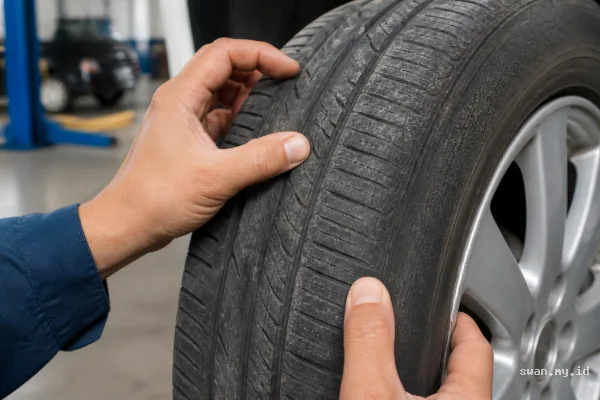
Swan.my.id - Jakarta, understanding car tire lifespan is essential because tires are the only vehicle components that directly contact the road. They carry the vehicle and passengers while affecting braking distance and stability.
However, many drivers still judge tire condition only by tread appearance or production codes. In reality, tire lifespan depends on pressure, driving habits, road conditions, vehicle load, wheel alignment, and age.
Drivers should inspect tires regularly and replace them when physical signs show that their safety has declined. Waiting for a tire to fail can increase the risk of losing control, especially at high speed or on wet roads.
Factors That Affect Car Tire Lifespan
Incorrect tire pressure is one of the main causes of premature wear. Underinflation can wear both outer edges and make the tire hotter, while overinflation can wear the center tread and reduce road grip.
Aggressive acceleration, hard braking, and high-speed cornering also accelerate tread wear. Rough roads, potholes, rocks, and overloaded vehicles place additional stress on the tread and sidewalls.
Wheel alignment and balancing matter as well. Incorrect alignment can create uneven wear on the inner or outer tread, while unbalanced wheels may cause steering-wheel vibrations at higher speeds.
Rubber also ages even when a vehicle is rarely used. Exposure to ultraviolet light, heat, and air pollution can reduce elasticity. Tires are generally advised to be replaced after three to five years, while five-year-old tires should be replaced even if the tread still looks thick.
Signs Your Tires Need Replacement
The tread should be checked through the Tread Wear Indicator, or TWI. If the tread surface has reached the small raised bars inside the grooves, the tire has reached its safety limit.
A distance of 40,000 kilometers is often used as a general point for a more serious inspection, although it is not an absolute replacement rule. Drivers should also watch for sidewall bulges, fine cracks, repeated air loss, frequent punctures, and uneven wear.
Bulges may indicate internal structural damage and can raise the risk of a sudden blowout. Fine cracks suggest that the rubber has dried and become brittle.
How to Maintain Tire Condition
Check tire pressure at least once a month and before long trips. Perform the check when the tires are cold for a more accurate reading.
Rotate the tires every 8,000 to 10,000 kilometers, along with alignment and balancing checks. Smooth driving, regular cleaning, and removing sharp objects or dirt from the wheel area can also help prevent premature damage.
Monitoring car tire lifespan is a basic part of safe driving. Replace tires when wear, age, cracks, bulges, or recurring leaks indicate that their performance is no longer reliable.
