

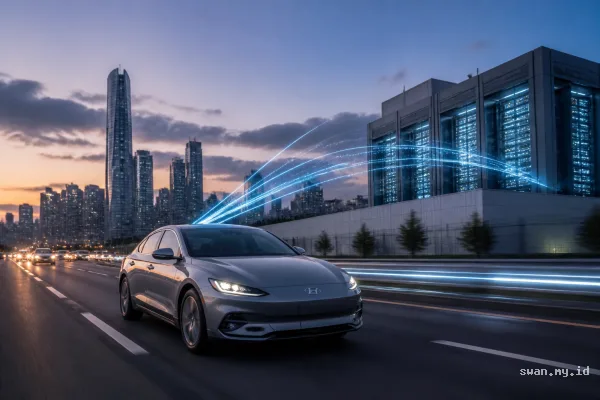
Swan.my.id - Jakarta, Hyundai Motor Group is building a “data flywheel” to strengthen its software-defined vehicle capabilities. The automaker plans to continuously collect and analyze data from millions of vehicles worldwide.
The strategy will support over-the-air updates, improved autonomous driving functions, and more capable AI-powered infotainment systems. Hyundai announced the plan during its 2026 CEO Investor Day presentation on Aug. 26.
The first phase will begin with Hyundai’s flagship Grandeur sedan in South Korea. The vehicle will use the company’s Pleos Connect infotainment system and Gleo AI, a new generative artificial intelligence assistant designed for in-car use.
Hyundai Data Flywheel Connects Vehicles and AI Development
A data flywheel creates a continuous feedback loop. Vehicle data is collected, analyzed, and then used to improve software, machine learning models, and future vehicle functions.
Hyundai said data from its vehicles and Kia vehicles will initially help enhance Gleo AI and develop new infotainment features. Gleo AI will focus on vehicle controls and convenience functions, while future integrations may connect it with other application services.
The automaker also plans to standardize its vehicle sensor architecture around Nvidia’s ecosystem. Hyundai says this approach will allow data collected by Hyundai, Kia, software subsidiary 42dot, and autonomous driving unit Motional to be used consistently across the group.
Autonomous Driving Development Will Use Fleet Data
Hyundai plans to introduce more advanced autonomous driving technology in stages. In collaboration with Nvidia, the company expects to add Level 2+ autonomous driving technology to its first mass-produced software-defined vehicle in 2028.
Data collected from those vehicles will support the development and updating of Atria AI, an in-house end-to-end autonomous driving system created by 42dot. By the end of 2026, Hyundai plans to deploy Atria AI on vehicles in South Korea to gather data from unexpected and unusual road situations, known as edge cases.
Hyundai eventually expects Atria AI to reach millions of additional vehicles across the group. The automaker says the broader fleet will help accelerate AI learning and improve support for Level 2+ and Level 4 autonomous driving capabilities.
Hyundai Prepares Large-Scale Data Infrastructure
Over the longer term, Hyundai aims to equip most mass-produced vehicles with standardized sensor systems and AI computing platforms. The company expects autonomous driving data from its connected fleet to grow rapidly from 2029.
To process that data, Hyundai is bringing online the Saemangeum AI Data Center in South Korea. The facility has a capacity of 100 megawatts and can house more than 50,000 GPUs, according to the company.
The data center will also connect data from Hyundai’s global production system with its integrated in-house AI. Hyundai says the infrastructure will help the group compete in the software-defined vehicle market while advancing autonomous driving capabilities.
What the Strategy Means for Future Vehicles
Hyundai’s approach links vehicle software, fleet data, computing infrastructure, and artificial intelligence into one development cycle. Each connected vehicle can contribute data that supports later updates and new capabilities.
However, the planned benefits depend on the automaker’s ability to deploy consistent sensors, computing platforms, and software across its brands and vehicle lines. The company’s staged plans indicate that infotainment improvements and data collection will come before wider autonomous driving applications.
With the Grandeur serving as an initial platform, Hyundai is positioning its global fleet as a foundation for future software-defined vehicles. The company’s stated targets include Level 2+ technology in 2028 and broader data processing capacity from 2029.
