
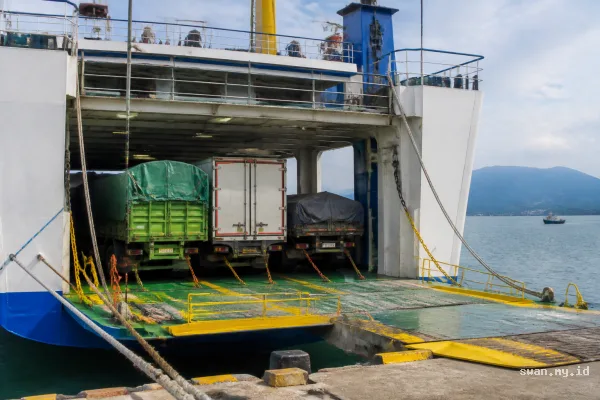
Swan.my.id - Jakarta, the National Transportation Safety Committee (KNKT) has called for Indonesia’s shipping safety regulations to be reviewed. The move aims to provide stronger guarantees for passenger, vehicle, and crew safety at sea.
KNKT Chairman Soerjanto Tjahjono said ineffective or unclear rules should be evaluated and revised. He made the statement during a webinar held by the Indonesian Transportation Society (MTI) on Friday night, September 18, as reported by Antara on Saturday, September 19.
One regulation highlighted by KNKT is Transportation Ministry Regulation PM 115 of 2016, which governs the transportation of vehicles on ships. The committee found several provisions that could create difficulties when applied in the field, particularly rules concerning vehicle lashing.
Shipping Safety Regulations Need Clearer Lashing Rules
Lashing refers to securing vehicles or other objects so they do not shift during a voyage. Soerjanto said PM 115 requires vehicles to be lashed, but also contains wording indicating that not every vehicle must receive lashing. KNKT considers this inconsistency in need of immediate revision.
He also said the regulation refers to lashing equipment with a strength of 10 tons. However, KNKT found that many lashing ropes had considerably lower strength. This condition could reduce the effectiveness of vehicle restraints during a voyage.
Heavy trucks present another challenge. Trucks weighing between 30 and 40 tons are required to use four securing devices on each side, while lashing should also be applied in an alternating arrangement. In practice, Soerjanto said many ships do not have enough lashing points for trucks weighing 30 tons or more.
Article 19 of PM 115 requires vehicles to remain secured during the voyage. The provision describes lashing for vehicles in the front, middle, and rear rows, while vehicles that are not lashed must have their wheels clamped.
Article 18 requires vehicles weighing between 30 and 40 tons to use at least four securing devices on each side. However, the provision does not specify the number of securing devices for vehicles exceeding 40 tons.
Technical Standards Also Require Attention
Regarding equipment strength, Article 10 states that securing devices without permanent deformation must have a strength of at least 120 kilonewtons. The 10-ton figure appears in an appendix as the safe working load for an example of securing equipment.
These provisions show the importance of aligning technical requirements with conditions aboard ships. Rules must not only set standards on paper but also consider whether ships have enough equipment and structural points to meet those standards.
KNKT Calls for Physical Ship Inspections
KNKT also recommended reviewing Transportation Ministry Regulation PM 28 of 2022. The regulation covers procedures for issuing sailing approval documents and approval for ship activities at ports.
Soerjanto said ship inspections should not focus solely on administrative documents. Physical inspections should also take place, even if they are conducted randomly. This approach would help verify whether a ship actually meets maritime safety standards before departure.
The physical checks should cover the ship’s construction and stability, machinery, safety equipment, and crew competence. Weather conditions and their potential contribution to accidents should also receive attention.
By reviewing the regulations and strengthening field inspections, KNKT expects shipping safety requirements to become clearer and more practical. The evaluation would also help ensure that rules concerning vehicle securing and sailing approval can be applied consistently across ships.
