

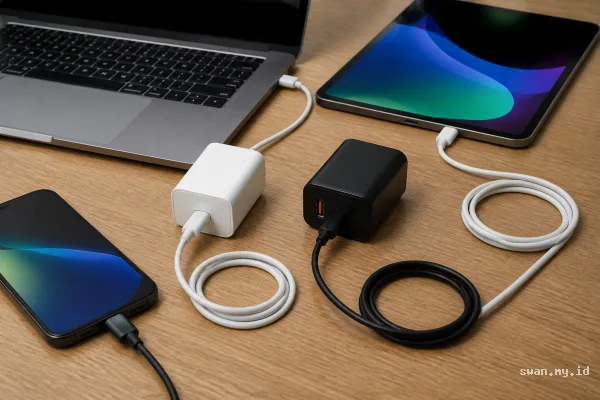
Swan.my.id - Jakarta, fast charging has become an important feature for smartphone, tablet, and laptop users. However, Power Delivery vs Quick Charge is not simply a matter of choosing the charger with the highest wattage.
Many consumers assume that every fast charger works in the same way. In practice, the charger, cable, and device must support compatible charging technology. If one component has a lower capability, the charging process will follow that limitation.
For example, a 65-watt charger cannot deliver its full output when paired with a cable designed for only 18 watts. Understanding the difference between Power Delivery and Quick Charge can therefore help users avoid slower charging, unstable connections, and unnecessary accessory purchases.
What Is Power Delivery?
Power Delivery, commonly called PD, is an open fast-charging standard developed through the USB organization. It generally uses USB Type-C and is designed to support devices from different manufacturers.
One of its main advantages is communication between the charger and the connected device. Before delivering higher power, both components exchange information about the required voltage and current. This allows the charging process to adjust to the device’s capabilities.
PD is used across a broad range of electronics, including smartphones, tablets, USB-C laptops, handheld game consoles, power banks, digital cameras, and other modern accessories. Its power range can begin at around 18 watts and extend beyond 100 watts for certain devices.
What Is Quick Charge?
Quick Charge, or QC, is a fast-charging technology developed by Qualcomm. It was initially designed for devices using Qualcomm Snapdragon processors, although some other manufacturers have adopted it through licensing.
QC increases voltage or current dynamically to charge a battery faster than a standard charger. The technology has developed through several versions, including QC 2.0, QC 3.0, QC 4, QC 4+, and QC 5, with later versions offering improved efficiency and protection features.
Quick Charge can work through USB-A or USB Type-C, depending on the charger’s design. It is commonly associated with compatible Android smartphones, QC-enabled power banks, car chargers, and some Android tablets.
Power Delivery vs Quick Charge: Key Differences
The main difference between Power Delivery and Quick Charge lies in their standards, compatibility, and common use cases. PD is an open standard with broad support across manufacturers, while QC is Qualcomm’s charging technology and is often optimized for compatible smartphones.
- Compatibility: PD generally supports a wider range of devices, while QC works best with devices that specifically support Quick Charge.
- Connector: PD commonly uses USB Type-C. QC can use USB-A or USB Type-C, depending on the charger.
- Device range: PD can support phones, tablets, laptops, cameras, consoles, and accessories. QC is more commonly focused on smartphones and related devices.
- Flexibility: A suitable 65-watt PD charger may serve a smartphone, tablet, laptop, power bank, or handheld console, provided each device supports the required standard.
These standards cannot be compared as if one is always better. PD is generally more practical for users with several USB-C devices. QC remains a suitable choice for smartphones designed to use that technology.
Why Charger and Cable Compatibility Matters
Choosing the correct standard helps users reach the maximum charging speed supported by their device. An incompatible charger may cause the device to return to standard charging speeds.
Compatibility also affects stability. If the charger, cable, and device cannot communicate properly, charging may become inconsistent. In addition, not every cable can safely carry higher current. An unsuitable cable may reduce performance, become excessively warm, or experience a shorter service life.
Fast-charging systems use communication and protection mechanisms to negotiate a suitable voltage and current. Using accessories that meet the required standards can help maintain a more stable charging process and reduce unnecessary strain on the charger, cable, and device.
Which Standard Should You Choose?
Users with smartphones, tablets, laptops, and other USB-C accessories may find PD more versatile because one compatible charger can serve several types of devices. It can also remain useful when users upgrade to another device that supports the same standard.
QC is a strong option when the primary device specifically supports Quick Charge. Before buying, check the device specifications, charger output, connector type, and cable capability instead of relying only on the “fast charging” label.
JakartaNotebook also provides categories for computer and laptop cables, USB cables, PCs, laptops, data cables, card readers, and laptop sleeves. The most important consideration remains matching every accessory with the charging requirements of the device.
