

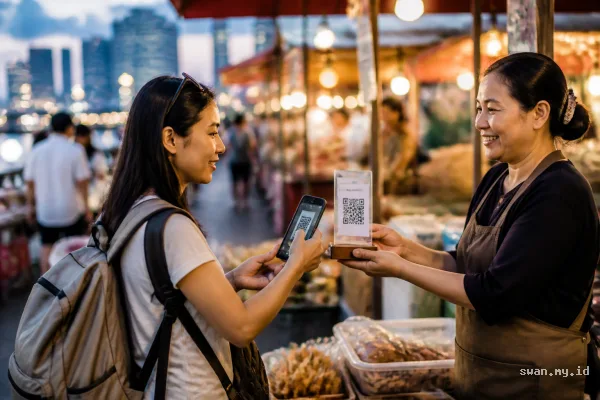
Swan.my.id - Jakarta, QRIS Cross-Border is making it easier for Indonesian travelers to pay for meals, shopping, and other purchases in several Asian destinations without carrying large amounts of local cash.
Saniah, a 54-year-old traveler from Bengkalis, Riau, experienced the convenience during an almost 10-day trip to Malaysia. When she found merchants displaying an accepted QR code, she opened her Indonesian payment application and completed the transaction by scanning it.
Malaysia was not her first overseas destination where she used QRIS. Before that trip, Saniah had also used the payment system in China and Japan. The experience reflects how a payment method commonly used in Indonesia is becoming part of cross-border travel.
QRIS Cross-Border follows rising travel activity
The expansion of cross-border QR payments comes as Indonesians continue to travel frequently across Asia. Singapore recorded 1,339,607 visitors from Indonesia between January and July 2026, according to data from the Singapore Tourism Board and the Singapore Department of Statistics.
Malaysia also remains a major destination for Indonesian tourists. Tourism Malaysia recorded 4.3 million visitors from Indonesia in 2025, an increase of 2.9 percent from the previous year.
Travel spending extends beyond flights and hotels. Visitors pay for meals, souvenirs, retail purchases, and services offered by micro, small, and medium enterprises. As a result, payment connectivity has become an important part of the travel experience.
Bank Indonesia developed QRIS Cross-Border to connect Indonesian payment applications with payment systems in partner countries. Indonesian travelers can scan codes accepted in those countries, while foreign visitors can use payment applications from their home countries at Indonesian merchants that support cross-border QR payments.
How the connected payment systems work
In Malaysia, the relevant QR standard is DuitNow QR. In Singapore, Indonesian travelers can make payments at merchants that accept NETS QR. From the user’s perspective, the process remains simple: open the payment application, scan the code, check the amount, and complete the payment.
Behind that simple process, however, payment systems in two countries must work together. Users can view the transaction value in rupiah, while merchants in the destination country receive payment in the local currency under the applicable mechanism. Transactions are processed in real time after completion.
Widi Agustin S, head of Bank Indonesia’s Singapore Representative Office, said the development supports more efficient financial transactions. The central bank also directs QRIS development toward retail payments that are fast, easy, affordable, secure, reliable, and inclusive.
Merchants and UMKM also benefit
The benefits extend to merchants. Dohartua Parlindungan Sihombing, owner of Hypnovintage in Singapore’s Haji Lane, said digital payments help customers review their purchase records through their accounts. That feature can strengthen customer trust in merchants.
Nazri, manager of Nasi Lemak Wanjo in Malaysia, also viewed digital payments as useful for both businesses and visitors. Customers do not need to carry large amounts of cash or search for a money exchange service before making a purchase.
Bank Indonesia recorded 65.77 million QRIS users and 44.86 million merchants as of June 2026. UMKM accounted for 96.68 percent of those merchants. This large domestic base gives cross-border connectivity a direct link to small businesses and tourism activity.
Cross-border transactions continue to grow
From its launch in May 2023 through February 2026, Indonesia-Malaysia QRIS Cross-Border transactions reached 10.66 million, with a total value of Rp2.75 trillion. Singapore recorded 554,510 transactions worth Rp179.28 billion between November 2023 and February 2026.
Thailand recorded 1.64 million transactions valued at Rp656.27 billion from August 2022 through February 2026. During 2025, foreign visitors using QRIS in Indonesia completed 5,892,621 inbound transactions, while Indonesians making payments abroad recorded 1,681,112 outbound transactions.
Bank Indonesia is continuing to promote wider acceptance through cooperation with central banks, payment infrastructure providers, airlines, and service companies. Its Garuda initiative, short for the Cross-Border QRIS Acceptance Movement for Digitalization and Acceleration, includes education for travelers arriving in Singapore.
QRIS connectivity has also expanded beyond Thailand, Malaysia, and Singapore to Japan, South Korea, and China. The broader effort is intended to support tourism, trade, consumption, and more efficient regional payment systems. For travelers such as Saniah, that complex network appears in a simple form: one application, one scan, and a completed payment.
