

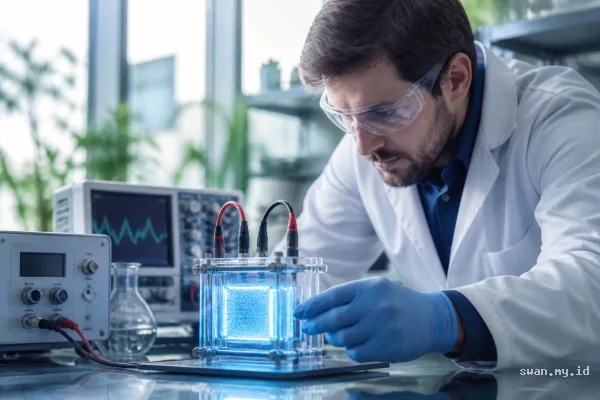
Swan.my.id - Jakarta, researchers are developing ionocaloric cooling technology that could reduce the reliance of air conditioners and refrigerators on conventional refrigerants such as hydrofluorocarbons, commonly known as HFCs or freon. The approach uses salt-based materials to absorb and move heat.
For decades, cooling systems have relied on refrigerants that circulate through a closed system. These materials absorb heat from an indoor space, change from liquid into gas, and then release the heat before condensing back into liquid. The cycle allows air conditioners, refrigerators, and water dispensers to produce cooling efficiently.
However, some refrigerants raise environmental concerns because they can contribute to global warming. As countries and industries seek to reduce greenhouse gas emissions, researchers are exploring alternatives that can deliver effective cooling without depending on potentially harmful chemical compounds.
How Ionocaloric Cooling Technology Works
According to IFLScience, the new method relies on the movement of ions and the physical changes that occur when a material shifts between different states. The principle resembles the way ice absorbs heat as it melts into water. During that process, the surrounding area loses heat and becomes cooler.
The researchers adapted this idea by using electrically charged particles, or ions, to trigger a similar transformation without simply raising the material’s temperature. The process takes inspiration from the practice of spreading salt on snowy roads. Salt interferes with ice formation and changes the conditions under which the material remains solid.
In the ionocaloric cycle, researchers add ions to a material so it can change phase and absorb heat. This cycle allows the system to transfer thermal energy while avoiding the conventional refrigerant process. The researchers believe the method could eventually support cooling equipment with a lower environmental impact.
Drew Lilley of Lawrence Berkeley National Laboratory said the field still lacks an alternative that combines efficiency, safety, and environmental benefits. “We think the ionocaloric cycle has great potential,” Lilley said.
Early Test Uses Salt and Carbon Dioxide
Scientists from Lawrence Berkeley National Laboratory and the University of California, Berkeley, tested the system with a salt mixture containing iodine and sodium. They used the mixture to melt ethylene carbonate, a material that can absorb heat during the phase-change process.
The production of the ethylene carbonate also added an environmental advantage. The researchers made the liquid using leftover carbon dioxide. As a result, the process did not merely aim for zero emissions. It could potentially produce negative emissions during material production by using carbon dioxide that would otherwise remain in the environment.
During the experiment, the system lowered the temperature to 25 degrees Celsius with only 1 volt of electrical power. The result demonstrates the potential of the approach, although the technology remains at the research and development stage.
Researchers Seek the Most Effective Salt
The team is now working to design a practical system that could support commercial production and real-world applications. Before manufacturers can adapt the method for air conditioners or refrigerators, researchers need to improve the system and identify materials that can move heat more effectively.
One key focus involves finding the most efficient type of salt for the cooling cycle. Recent research points to nitrate-based salts as promising candidates because they may improve heat absorption inside the system.
Nevertheless, ionocaloric cooling technology still needs further development before consumers can use it in household appliances. Researchers must translate the laboratory process into a reliable, practical, and scalable design. If that effort succeeds, salt-based cooling could offer the industry a new path beyond conventional HFC refrigerants.
Potential Impact on Future Cooling Systems
Air conditioners and refrigerators account for widespread demand for cooling technology. Therefore, replacing conventional refrigerants with a system that uses less harmful materials could support broader efforts to limit greenhouse gas emissions.
The early findings do not mean that ionocaloric systems will immediately replace existing appliances. However, the low-voltage test and the use of salt-based materials provide researchers with a foundation for further work. In addition, the use of carbon dioxide during material production adds another environmental consideration to the technology.
Ultimately, the success of this approach will depend on efficiency, safety, durability, and the ability to manufacture the system at scale. For now, the ionocaloric cycle remains an emerging research direction, but it offers a possible alternative for the future of cooling.
