

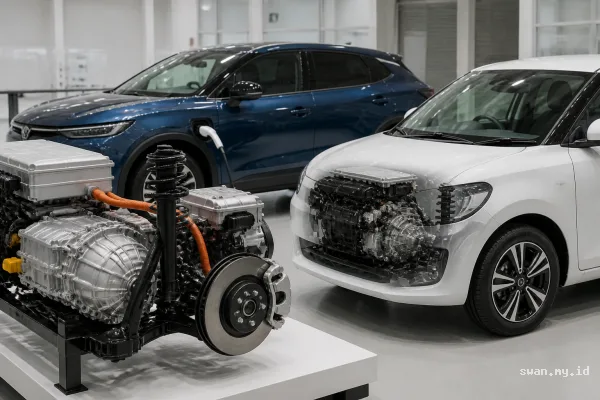
Swan.my.id - Jakarta, Suzuki is preparing an electric and hybrid technology strategy to respond to changes in the automotive industry over the next decade. The Japanese automaker is developing several powertrain technologies, including turbocharged gasoline engines, mild-hybrid systems, hybrid powertrains, and fully electric vehicles.
At the same time, Suzuki wants to increase the use of shared components across different vehicle types. The company expects this approach to make the development of new cars faster and more efficient.
Suzuki’s strategy covers more than one type of powertrain. Instead, the automaker is preparing several solutions that can serve different vehicle sizes and driving needs. This approach allows Suzuki to continue developing electric vehicles while also improving hybrid and combustion-engine technologies.
Suzuki Develops a Shared 6-in-1 E-Axle
One of the technologies under development is the e-Axle 3-in-1 system. Suzuki currently uses this system in the e Sky, an electric kei car. In the future, the company plans to develop the system into a 6-in-1 unit while maintaining the same dimensions.
The future system could support both fully electric cars and hybrid vehicles. By using a shared unit, Suzuki aims to create a more flexible technology base for several models.
This development also reflects Suzuki’s plan to use more common components in its vehicle lineup. Consequently, the company can apply related technologies to different vehicle categories without creating an entirely separate system for every model.
Different Electric Motor Outputs for Various Models
For urban electric vehicles such as the e Sky, Suzuki plans to use a front electric motor producing 94 horsepower. The four-wheel-drive version will receive an additional rear motor with an output of 13 horsepower.
Meanwhile, Suzuki is preparing a larger electric vehicle with a main electric motor producing 174 horsepower. The system can also pair with a 40-horsepower rear electric motor to support four-wheel drive.
These output options show how Suzuki intends to adapt its electric technology to different vehicle sizes. Smaller urban models can use a lower-output configuration, while larger vehicles can receive a more powerful main motor and an additional rear motor.
Focus on Easier Recycling
Suzuki also plans to reduce the use of materials containing heavy rare-earth elements in its electric motors. The company is taking this step to make the motors easier to recycle after they reach the end of their service life.
This consideration forms another part of Suzuki’s electric vehicle development. The automaker is not only focusing on motor output and drivetrain layouts, but also on the materials used in its technology.
Reducing heavy rare-earth content could support a simpler recycling process for electric motors. However, Suzuki’s current development remains part of its broader preparation for future electric and hybrid vehicles.
Small Models to Receive New Mild-Hybrid Systems
Besides electric vehicles, Suzuki continues to develop hybrid technology. For smaller models, the company is preparing a new mild-hybrid system.
Suzuki targets a 15 percent reduction in carbon emissions from this mild-hybrid technology. The system will expand the company’s range of powertrain options for compact vehicles.
Alongside mild-hybrid technology, Suzuki is also developing conventional hybrid systems and turbocharged gasoline engines. Therefore, the company’s future strategy will combine several technologies rather than rely on only one powertrain type.
Overall, Suzuki is building a flexible technology foundation for the next decade. The plan includes shared components, electric drive systems for several vehicle sizes, hybrid options, mild-hybrid technology, and turbocharged gasoline engines. Through this approach, Suzuki aims to respond to the evolving automotive industry while improving development efficiency across its future lineup.
