

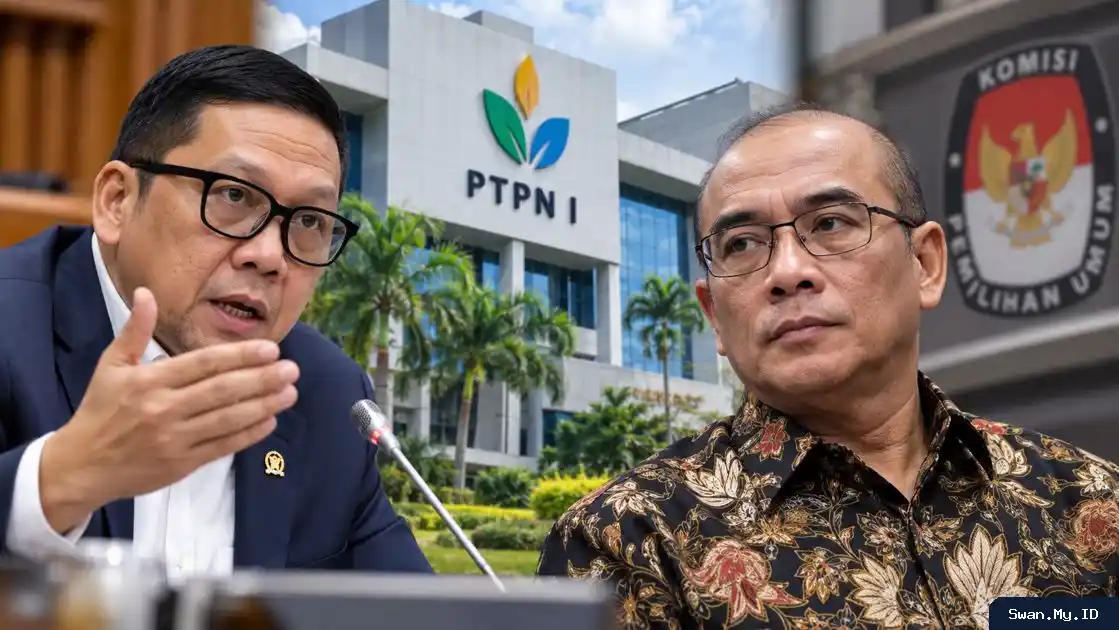
Swan.my.id - Jakarta, Indonesia, Ahmad Doli Kurnia Tanjung has questioned the appointment of former General Elections Commission (KPU) chairman Hasyim Asy’ari as an independent commissioner at state-owned plantation company PT Perkebunan Nusantara I (PTPN I). Doli wants Hasyim to explain the background of his appointment, particularly because his professional experience does not directly relate to the plantation industry.
The lawmaker’s remarks have drawn attention to Hasyim’s transition from election administration and academia to a supervisory position at a state-owned enterprise. The appointment also comes amid renewed public discussion about Hasyim’s previous decisions during his leadership of the KPU.
The debate intensified after Hasyim criticized people who questioned the emergence of Article 18 paragraph (3) in KPU Regulation No. 19/2023. The provision became controversial during proceedings at Indonesia’s Constitutional Court because critics viewed it as opening a path for Gibran Rakabuming Raka to run as a vice-presidential candidate in the 2024 presidential election.
Ahmad Doli Questions Hasyim’s PTPN I Appointment
Doli, a member of Commission II of the House of Representatives (DPR), has questioned the reasoning behind Hasyim’s appointment as an independent commissioner. His main concern centers on the connection between Hasyim’s professional background and the responsibilities associated with the plantation business.
Hasyim built much of his career in constitutional law, political science, electoral administration, and higher education. He worked as a university lecturer for decades and held several positions within the KPU before becoming its chairman.
However, his appointment to PTPN I raises a broader question about the qualifications expected of commissioners at state-owned enterprises. These officials help oversee corporate governance, evaluate management performance, and monitor a company’s strategic direction.
Doli’s comments focus on the need to clarify why Hasyim was selected for the position. Nevertheless, questions about his industry-specific experience do not, by themselves, establish whether he meets the formal requirements for the role.
As of the latest information available in the report, Hasyim, PTPN I, and the Ministry of State-Owned Enterprises had not issued official statements addressing Doli’s questions about the appointment.
Controversy Surrounding KPU Regulation No. 19/2023
The debate over Hasyim’s new position follows renewed scrutiny of his tenure as KPU chairman. The controversy concerns Article 18 paragraph (3) of KPU Regulation No. 19/2023, a provision that attracted attention during proceedings at the Constitutional Court.
Critics argued that the provision created a route for Gibran Rakabuming Raka to qualify as a vice-presidential candidate in the 2024 election. The issue became politically sensitive because it involved the rules governing candidate eligibility and the KPU’s responsibility for administering elections.
Hasyim rejected allegations that the KPU had secretly inserted the provision into the regulation. Instead, he argued that responsibility for the provision involved the participants in the relevant public hearing and consultation process.
He also called on the Election Organizers Ethics Council (DKPP) to handle complaints concerning the provision fairly, proportionately, and carefully. In addition, he urged the council to avoid conflicts of interest while examining the matter.
During his remarks, Hasyim delivered a pointed message to those involved in the debate. “Because of that, on this occasion, I want to appeal to everyone: forgetting is acceptable, but hypocrisy is not,” he said.
His statement added another dimension to the public discussion. However, the controversy surrounding the election regulation and Doli’s questions about the PTPN I appointment concern different issues. The first involves election administration and ethics, while the second concerns the rationale for selecting a commissioner at a state-owned company.
Hasyim Asy’ari’s Education and Academic Career
According to the official PTPN I company profile, Hasyim was appointed as an independent commissioner on June 30, 2026. He was born in Pati, Central Java, on March 3, 1973.
His academic background includes constitutional law, political science, and political sociology. He completed the following degrees during his academic career:
- 1995: Bachelor’s degree in constitutional law from Jenderal Soedirman University.
- 1998: Master’s degree in political science from Gadjah Mada University.
- 2012: Doctoral degree in political sociology from the University of Malaya.
Hasyim began working as a lecturer at the Faculty of Law at Diponegoro University in 1998. His academic career provided a foundation for his subsequent involvement in constitutional and electoral affairs.
His experience in higher education also distinguishes his professional profile from that of executives who have spent their careers in agriculture, plantation operations, or corporate management. Still, the available profile does not establish that his academic background alone determined his selection for the commissioner position.
From Election Commissioner to PTPN I Board Member
Hasyim’s career in election administration began before his appointment as KPU chairman. He served as an interim replacement member of the commission from 2016 to 2017, then became a full member for the 2017–2022 period.
He subsequently led the KPU during the 2022–2024 term. In that capacity, he held a central role in Indonesia’s election administration, including the period surrounding the 2024 presidential election.
His career progression can be summarized as follows:
- Lecturer at the Faculty of Law, Diponegoro University, beginning in 1998.
- Interim replacement member of the KPU from 2016 to 2017.
- KPU member for the 2017–2022 term.
- KPU chairman for the 2022–2024 term.
- Independent commissioner at PTPN I, appointed on June 30, 2026.
This record shows extensive experience in academia and public administration. Nevertheless, Doli’s questions highlight the importance of explaining how that experience relates to the oversight needs of a plantation company.
PTPN I Profile Details and Independence
PTPN I’s official profile states that Hasyim has no affiliation with the company’s directors, board of commissioners, or principal and controlling shareholders. It also records that he does not own shares in the PTPN Group.
These disclosures address potential financial and organizational ties. However, the absence of reported affiliations does not, on its own, explain the criteria used to select him or establish the extent of his relevant industry expertise.
An independent commissioner generally contributes to corporate oversight, governance, and accountability. In a plantation business, those responsibilities can involve reviewing strategic decisions and monitoring management performance. Therefore, the relationship between a candidate’s professional experience and the company’s needs remains an important consideration in public discussions about appointments.
The available company profile provides details about Hasyim’s education, career history, appointment date, and reported affiliations. It does not, however, provide a definitive answer to Doli’s questions about the selection process.
Official Clarification Remains Outstanding
The questions surrounding Hasyim’s appointment remain unresolved in the available report. Doli has called for an explanation, while no official response from Hasyim, PTPN I, or the Ministry of State-Owned Enterprises has addressed his concerns.
A clear explanation of the appointment process could help establish which qualifications and considerations informed the decision. It could also distinguish the formal eligibility requirements from broader public expectations about relevant professional experience.
For now, Hasyim’s documented career includes years of academic work and senior responsibilities in election administration. Meanwhile, the debate over his appointment to PTPN I centers on whether that experience adequately matches the company’s oversight requirements and why the appointing authorities selected him.
Ultimately, an official explanation from the relevant parties would provide a firmer basis for assessing the appointment. Until then, Doli’s questions remain part of the public discussion rather than a settled conclusion about Hasyim’s qualifications or the reasons behind his selection.
Frequently Asked Questions
Who questioned Hasyim Asy’ari’s appointment as a PTPN I commissioner?
Ahmad Doli Kurnia Tanjung, a member of Commission II of Indonesia’s House of Representatives, questioned the appointment and called for clarification about Hasyim’s professional background.
When did Hasyim Asy’ari become a PTPN I independent commissioner?
According to PTPN I’s official company profile, Hasyim was appointed on June 30, 2026.
What is Hasyim Asy’ari’s professional background?
He has worked as a law lecturer at Diponegoro University since 1998 and previously served as a KPU member and chairman. His academic qualifications include degrees in constitutional law, political science, and political sociology.
Why did the KPU regulation become controversial?
Article 18 paragraph (3) of KPU Regulation No. 19/2023 drew scrutiny during Constitutional Court proceedings because critics argued that it opened a path for Gibran Rakabuming Raka to run as a vice-presidential candidate in the 2024 election. Hasyim denied that the KPU had secretly inserted the provision.
Has PTPN I officially responded to Doli’s questions?
The available report does not include an official response from Hasyim, PTPN I, or the Ministry of State-Owned Enterprises addressing Doli’s questions about the appointment.
