

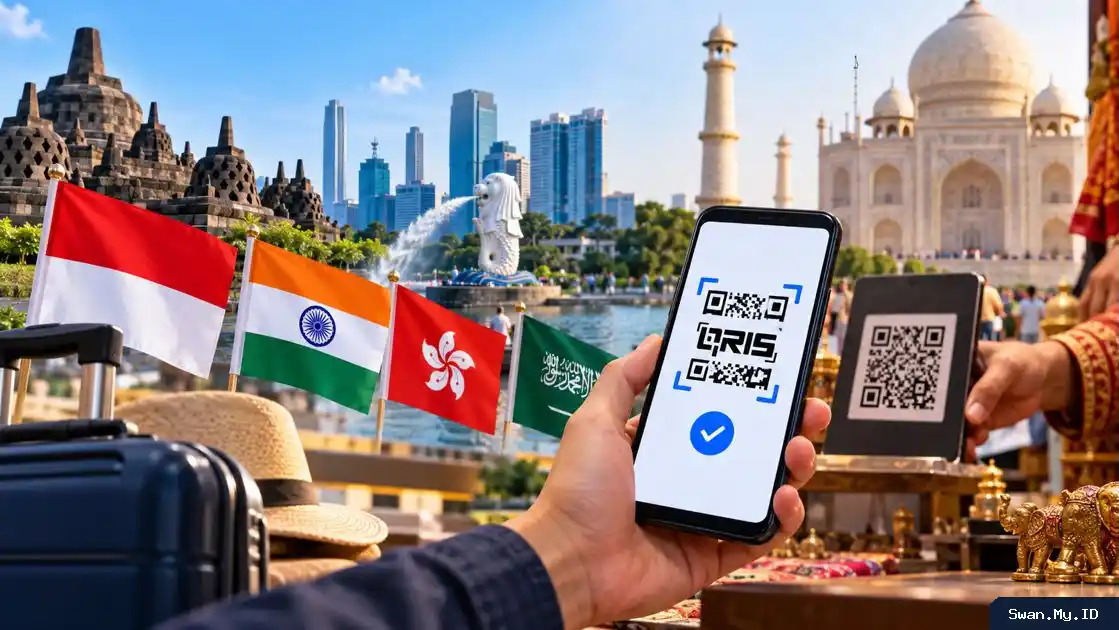
Swan.my.id - Jakarta, Indonesia, Bank Indonesia is expanding its efforts to bring Quick Response Code Indonesian Standard (QRIS) cross-border payments to more international markets, including India, Hong Kong, and Saudi Arabia. The initiative aims to make international transactions easier, faster, and more accessible for travelers and other users.
Bank Indonesia Governor Destry Damayanti confirmed that she had discussed potential cooperation with India's central bank before holding talks with Timor-Leste on cross-border QR payments. The discussions reflect Indonesia's broader ambition to strengthen digital payment connectivity with countries that maintain significant travel and economic links with Indonesia.
Meanwhile, Timor-Leste has officially joined the QRIS cross-border ecosystem, becoming its seventh participating country. Bank Indonesia is also exploring cooperation with Hong Kong and hopes to establish a similar payment arrangement with Saudi Arabia, which could benefit Indonesians traveling for the Hajj and Umrah pilgrimages.
Bank Indonesia Explores QRIS Cross-Border Cooperation With India
Destry said Bank Indonesia had met with India's central bank approximately one month before signing the cooperation agreement with Timor-Leste. During the meeting, both sides discussed the possibility of connecting their payment systems through QR-based transactions.
According to Destry, the opportunity stems partly from the movement of tourists between Indonesia and India. Both countries have an interest in making payments more convenient for visitors who travel across their borders.
She explained that the initiative focuses on improving services and reducing friction when people make payments abroad. As a result, travelers could eventually use familiar digital payment methods instead of relying entirely on conventional cash transactions.
Destry shared the explanation with CNBC Indonesia in comments cited on October 12, 2026. However, the discussions with India remain part of the cooperation process, rather than confirmation that QRIS cross-border payments are already operational there.
If the two central banks reach an agreement and complete the necessary technical preparations, the connection could widen the reach of Indonesia's digital payment infrastructure. Nevertheless, the actual launch would depend on further coordination and implementation arrangements.
QRIS Cross-Border Now Connects Seven Countries
Bank Indonesia said QRIS cross-border payments currently connect Indonesia with seven countries. The ecosystem supports inbound and outbound transactions, allowing eligible users to make payments across participating markets through connected QR payment arrangements.
The seven participating countries are:
- China
- South Korea
- Thailand
- Malaysia
- Singapore
- Japan
- Timor-Leste
Timor-Leste joined the ecosystem during the Digital Financial Economy Festival on September 25, 2026. Its participation represents another step in Indonesia's efforts to expand the international reach of QRIS.
Furthermore, the expansion could help businesses serve international visitors more efficiently. When participating payment systems work together, customers may be able to scan compatible QR codes and pay through supported applications, subject to local rules and service availability.
However, users should not assume that every payment application works in every participating country. Actual availability depends on the participating financial institutions, supported applications, merchant acceptance, exchange-rate arrangements, and applicable transaction rules.
Indonesia and Hong Kong Agree to Explore QR Payment Connectivity
Bank Indonesia and the Hong Kong Monetary Authority (HKMA) have also agreed to explore cross-border QR payment cooperation. The two institutions formalized their commitment through a memorandum of understanding signed on September 24, 2026.
Destry Damayanti signed the memorandum on behalf of Bank Indonesia, while HKMA Chief Executive Eddie Yue represented Hong Kong's monetary authority. The agreement establishes a framework for further discussions about cooperation in QR code-based cross-border payments.
According to Bank Indonesia's announcement, both institutions intend to strengthen bilateral relations and develop effective mechanisms for international payment connectivity. Their shared objectives include making cross-border payments faster, more accessible, transparent, and inclusive.
Under the memorandum, the two sides will discuss relevant technical, operational, and regulatory matters. They will also explore possible arrangements to make their QR-based payment systems interoperable.
Interoperability is important because separate payment networks do not automatically communicate with one another. Therefore, both authorities must address the standards, operating procedures, and regulatory requirements needed to support transactions across their respective systems.
The memorandum marks a step toward potential cooperation, but it does not itself confirm that a fully operational QR payment connection between Indonesia and Hong Kong is available. Further discussions and implementation work will determine the scope and timing of any future service.
Bank Indonesia Targets Saudi Arabia for Hajj and Umrah Travelers
Beyond India and Hong Kong, Bank Indonesia hopes to establish similar payment cooperation with Saudi Arabia. The initiative could be particularly useful for Indonesian Muslims traveling to the country for the Hajj and Umrah pilgrimages.
BI Deputy Governor Filianingsih Hendarta explained that direct digital payments could reduce the need for travelers to exchange physical cash before or during their trips. She described a future in which pilgrims could use their mobile phones and maintain sufficient funds in supported payment accounts.
For Indonesian pilgrims, this approach could simplify everyday spending, including purchases from participating merchants. Moreover, travelers might spend less time managing cash exchanges and could find it easier to monitor their transactions through digital payment applications.
Nevertheless, these benefits depend on the establishment of an official payment connection and the availability of compatible services in Saudi Arabia. Travelers would still need to check which applications, merchants, transaction limits, and funding methods support the service before relying on it abroad.
Bank Indonesia's interest in Saudi Arabia also illustrates how cross-border QR payments could address practical needs beyond tourism. Religious travel involves large numbers of Indonesian visitors, making convenient payment options a relevant area for future cooperation.
What QRIS Expansion Could Mean for Indonesian Travelers
Expanding QRIS cross-border connectivity could bring several potential benefits to people who travel internationally. These advantages would depend on the payment arrangements that participating institutions eventually implement.
- More convenient payments: Travelers could use supported mobile payment applications at participating merchants instead of carrying large amounts of cash.
- Simpler spending management: Digital transaction records could help users review their purchases and monitor their expenses.
- Broader merchant access: A connected payment network could allow more eligible merchants to accept payments from visitors using supported systems.
- Improved payment connectivity: Cooperation between central banks could help establish compatible standards and operating arrangements across markets.
- Greater payment accessibility: Simpler digital payment options could benefit travelers who prefer mobile transactions over cash exchanges.
However, QR payments do not automatically eliminate every cost or practical challenge associated with spending abroad. Exchange rates, transaction fees, connectivity, application compatibility, and merchant acceptance can still affect the user experience.
For this reason, travelers should continue to prepare alternative payment methods until a cross-border service becomes officially available and its operating conditions are clear.
Conclusion
Bank Indonesia is pursuing a wider QRIS cross-border network through discussions with India, an agreement to explore cooperation with Hong Kong, and plans to seek a similar arrangement with Saudi Arabia. These efforts follow the expansion of the existing network to seven participating countries, including Timor-Leste.
The overall objective is to make international digital payments more convenient and accessible for Indonesians and visitors from partner countries. If the planned connections move forward, they could support tourism, improve payment options for pilgrims, and strengthen cooperation between financial authorities.
For now, the discussions and memorandum of understanding represent steps toward future connectivity, not confirmation that QRIS payments already operate in India, Hong Kong, or Saudi Arabia. Further agreements and technical preparations will determine when these potential services can become available.
Frequently Asked Questions
What is QRIS cross-border?
QRIS cross-border is a payment arrangement that connects Indonesia's QR payment standard with compatible systems in other countries. It allows eligible users to make QR-based payments across participating markets under the applicable service rules.
Which countries currently participate in QRIS cross-border?
The seven participating countries identified by Bank Indonesia are China, South Korea, Thailand, Malaysia, Singapore, Japan, and Timor-Leste.
Will Indonesians be able to use QRIS in India?
Bank Indonesia has discussed potential cooperation with India's central bank. However, the discussions do not confirm that QRIS cross-border payments are already available in India.
Why is Bank Indonesia exploring cooperation with Saudi Arabia?
The proposed cooperation could make payments more convenient for Indonesians traveling for Hajj and Umrah. In particular, compatible mobile payment services could reduce the need to exchange physical cash, once the necessary arrangements are in place.
Is QRIS cross-border already available in Hong Kong?
Bank Indonesia and the Hong Kong Monetary Authority signed a memorandum of understanding to explore QR-based cross-border payment cooperation on September 24, 2026. The memorandum establishes a framework for further discussions, rather than confirming that the service is already operational.
[/CONTENT]