

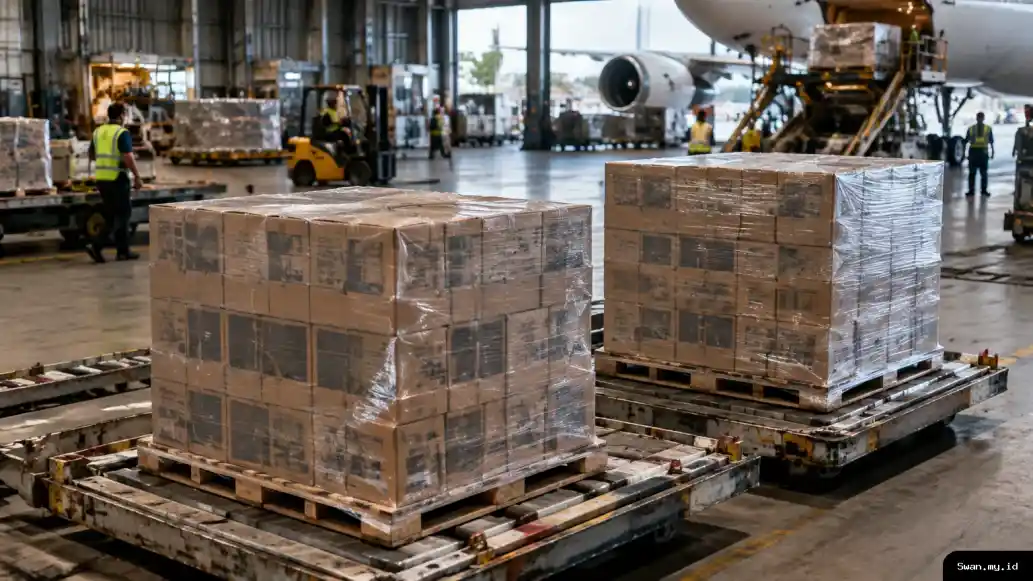
Swan.my.id - A missing RTX 5090 shipment has left Brazilian technology distributor Oderço seeking answers after two pallets of graphics cards could not be located at São Paulo’s Guarulhos International Airport. The shipment’s estimated value is 2.5 million Brazilian reals, or about $470,000 and Rp 7.8 billion.
The cargo contained Zotac GeForce RTX 5090 cards and was expected to arrive at the airport. However, Oderço says it still does not know where the pallets are. The company has sought an explanation, but has not received an official response clarifying the shipment’s whereabouts.
What is known about the missing RTX 5090 shipment
Oderço has identified the missing cargo as two pallets of Zotac RTX 5090 graphics cards. It has not disclosed the shipment’s precise arrival date, a tracking number, or the number of individual cards inside. As a result, the available information does not establish how many GPUs were lost.
The company shared the incident on its official Instagram account after it failed to obtain clarity. Oderço said it had never faced a similar event during its 38 years distributing electronics and information technology products. That statement conveys the company’s experience, but it does not explain how the pallets disappeared.
At this stage, the cause remains unknown. The information available does not confirm theft, a handling mistake, or any other specific explanation. Without details about the shipment’s tracking history or the airport’s handling process, it would be premature to assign responsibility.
That uncertainty also limits what can be said about the next steps. Oderço has publicly sought answers, but no official explanation about the cargo’s location has been reported. The exact point at which the pallets went missing is also unclear.
Why the reported value does not reveal the card count
The stated value offers a useful measure of the shipment’s scale, but it cannot be used to calculate an exact unit count. Oderço described the 2.5 million reals as the procurement cost of the cargo. That figure is different from a consumer retail price.
For comparison, Brazilian retailer Promotech listed a Zotac Gaming GeForce RTX 5090 for 33,999.99 reals. Dividing the shipment’s reported value by that retail price produces a rough equivalent of about 73 cards. However, this is only a comparison, not a confirmed count of the GPUs in the pallets.
Retail pricing does not necessarily match what a distributor pays to acquire products. Therefore, the actual number could differ from that simple calculation. Oderço has not published a card count, and the available figures do not provide enough information to determine one.
Prices and availability can also vary between sellers and markets. In this case, the reported purchase value explains why the incident has attracted attention, but it should not be confused with a detailed inventory or a final assessment of the loss.
RTX 5090 scarcity adds context
The disappearance comes amid reports that Nvidia’s flagship gaming graphics card has become harder to find in some markets. Tom’s Hardware reported that the RTX 5090 began vanishing from several online stores in mid-September 2026. Some retailers have also shown limited availability or removed the product from their online listings.
One United States computer retailer, Micro Center, listed the RTX 5090 as “not carried” online. That wording indicates the card was not available in the store’s online product range. It does not, by itself, prove that Nvidia stopped making the GPU or that every retailer has run out.
Reports of tight supply have prompted speculation that Nvidia might shift production capacity toward professional hardware for artificial intelligence, which can be more profitable. Nvidia has denied rumors that it ended RTX 5090 production. The company’s denial is important context, but it does not answer questions about Oderço’s specific cargo.
The RTX 5090 sits at the high end of Nvidia’s gaming lineup. It targets users who need substantial graphics performance, including people playing at high resolutions or handling demanding computing tasks. Its price and reported scarcity make a shipment of multiple units especially valuable to distributors.
Key questions remain unresolved
The central issue is still straightforward: no one has publicly confirmed where the two pallets are. The reported value is substantial, yet the shipment’s precise contents and last known movements remain undisclosed. Those gaps prevent a clear account of what happened.
Nor has any available information established that the cargo was stolen. Packages and computer components have been involved in theft and fraud cases elsewhere, but those examples do not prove a connection to Oderço’s shipment. Each case requires its own evidence.
For now, the incident remains a missing-cargo case with unanswered logistical questions. A clear account would need to establish when the pallets reached the airport, how they were recorded, and where tracking stopped. Until those details emerge, the cause and the cards’ whereabouts remain unknown.
