

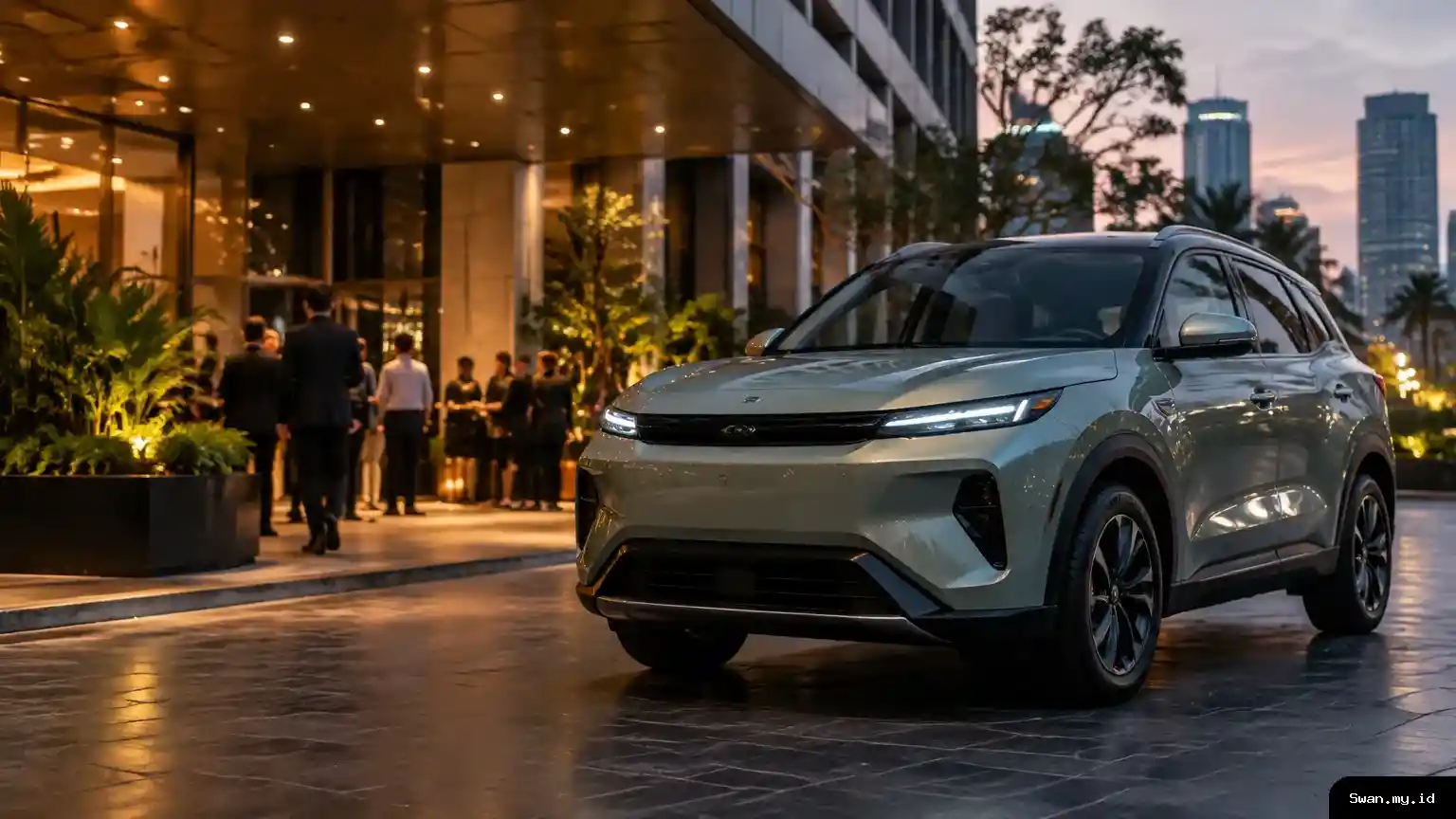
Swan.my.id - The BYD Atto 2 Indonesia launch is drawing attention as the electric SUV approaches a possible local debut. A reported starting price of around Rp 300 million places it near the Jaecoo J5 EV, while BYD has highlighted its next-generation battery and fast-charging capability. However, several important details remain unconfirmed.
BYD Indonesia displayed the Atto 2 at its Flash Charging event in Jakarta on October 14, 2026. Visitors could see the vehicle’s exterior, but the company kept its cabin under wraps. That limited showing gave the market a first look at the SUV without answering questions about its Indonesian equipment or final price.
BYD Atto 2 Indonesia pricing remains an estimate
An Otohub report puts the Atto 2’s expected starting price at around Rp 300 million. That figure is an estimate, not a confirmed retail price from BYD. The company has not announced the Indonesian model’s grades, equipment packages, or final pricing.
The estimate matters because it puts the Atto 2 close to a current rival. The top Jaecoo J5 EV variant is priced at Rp 324 million, according to the report. If BYD launches the Atto 2 near its estimated entry price, buyers could soon compare two electric SUVs in a similar spending range.
Still, the comparison should remain provisional. A starting price does not establish that the Atto 2 and J5 EV will offer equivalent range, features, or ownership packages. Until BYD publishes local specifications, buyers can treat the price overlap as an early indication of where the SUV may compete.
The vehicle’s China-market prices provide context, but they do not confirm its Indonesian positioning. In China, the Atto 2 is offered with claimed ranges of 301 kilometres and 401 kilometres. The respective prices listed there are 96,800 yuan, approximately Rp 214.7 million, and 119,800 yuan, approximately Rp 265.8 million.
Those converted figures are not a guide to the Indonesian price by themselves. Local pricing may differ, and BYD has not confirmed whether Indonesia will receive the same versions. The China range figures also should not be mistaken for confirmed range ratings for the Indonesian model.
Blade Battery 2.0 and rapid charging claims
One local-market detail has received more clarity: BYD President Director Eagle Zhao said the Indonesian Atto 2 will use Blade Battery 2.0. He also linked the battery to the company’s Flash Charging technology, giving the upcoming SUV a headline feature beyond its expected price positioning.
BYD’s stated charging figures are striking. Under normal environmental conditions, the system is claimed to charge the battery from 10 to 70 percent in five minutes. The company also claims that charging from 10 to 97 percent can take nine minutes.
These are manufacturer claims, not a guarantee of identical results in every setting. The figures depend on the stated conditions, and the available information does not specify the charging equipment or other variables for an Indonesian customer’s session. Buyers will need further local details to understand how the system works in practice.
Even so, the claims show the role BYD wants charging speed to play in the Atto 2’s appeal. Faster charging could make an electric SUV more convenient for drivers who rely on public charging or take longer trips. The final experience will depend on the charging infrastructure available to owners, as well as the vehicle’s confirmed local specifications.
Platform and design offer clues, not a full specification
BYD describes the Atto 2 as a modern SUV with a sportier character. The vehicle uses the company’s e-Platform 3.0, a platform developed specifically for electric vehicles. Those details establish its basic identity, but they do not reveal the full equipment list or performance figures for the Indonesian version.
The exterior display in Jakarta offered only a partial introduction. Since BYD did not allow visitors to see the interior, cabin design and features remain unknown locally. The company has also yet to publish complete Indonesian specifications, so details such as the final trim lineup and local range should wait for an official announcement.
For shoppers, that distinction between confirmed and outstanding information is important. The battery generation and platform have been identified, while price, cabin details, and local range have not. As a result, the Atto 2 is easier to place in the market than to assess as a complete ownership proposition.
Launch timing depends on BYD’s preparations
Otohub reported that the Atto 2 could launch the following month, alongside the BYD Ti7. That points to a possible November 2026 introduction, based on the report’s October publication. However, BYD has not confirmed an exact launch date.
Zhao said the company would launch the SUV after completing the necessary preparations, including readiness at its factory. He described the launch as coming in the near future but did not provide a firm schedule. His comments leave room for the timing to depend on preparations rather than a fixed public date.
Production readiness is especially relevant because a launch involves more than displaying a vehicle. BYD still needs to complete the preparations it considers necessary before introducing the model. Until the company confirms those steps and announces the date, the reported timeline should be treated as tentative.
The Atto 2’s early profile is therefore clear in some respects and open in others. It is an electric SUV built on BYD’s dedicated EV platform, and its Indonesian version is set to use Blade Battery 2.0. A price near Rp 300 million and a possible November arrival could put it directly in view of buyers considering the Jaecoo J5 EV, but both the final price and launch schedule still await confirmation.
For now, the strongest reason to watch the Atto 2 is the combination of a potentially accessible price and ambitious charging claims. The next announcement should clarify whether its local range, equipment, and cabin can match that promise. Until then, the vehicle remains a forthcoming contender rather than a fully specified choice for Indonesian EV buyers.
