

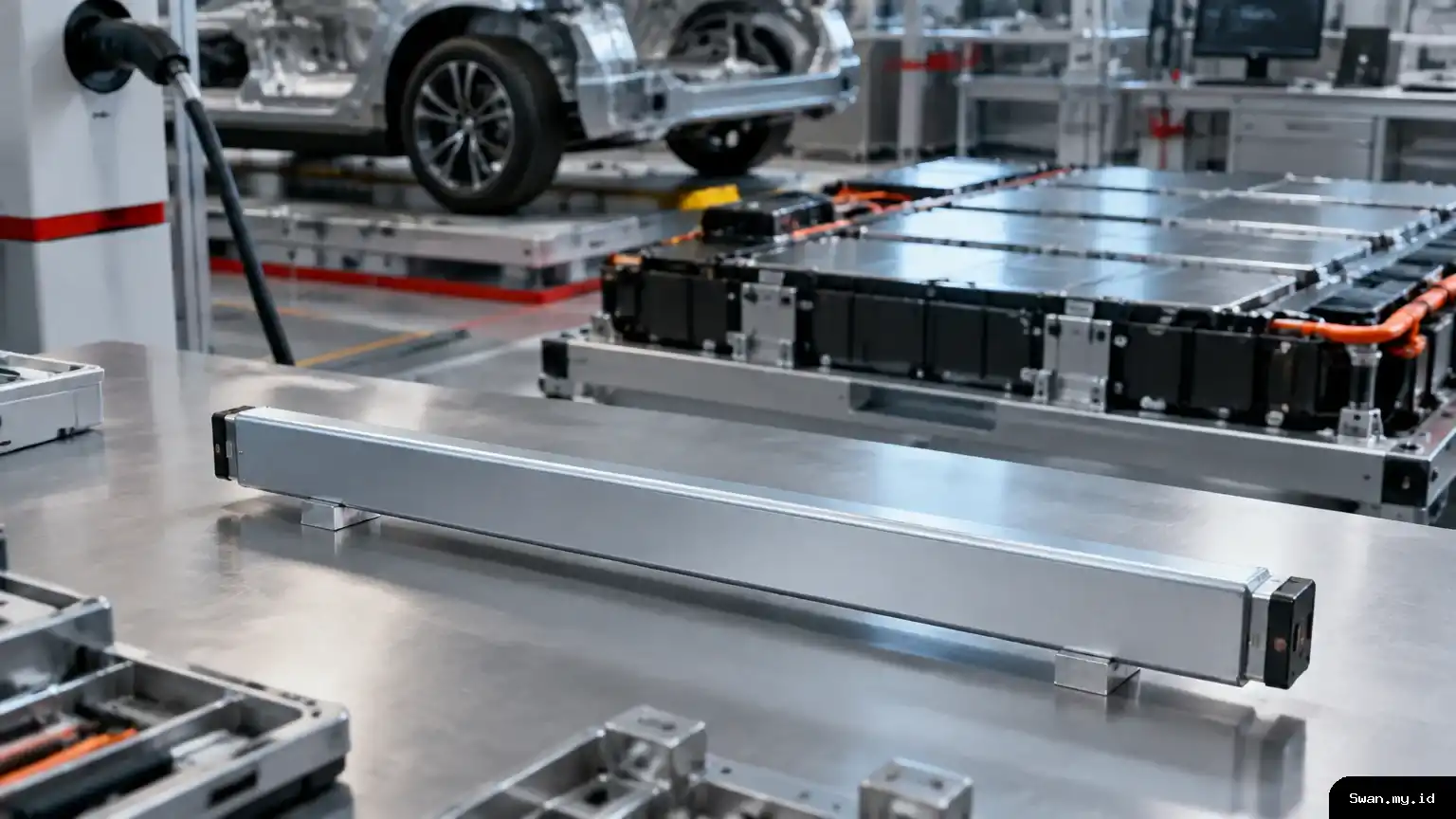
Swan.my.id - BYD Blade Battery 2 is designed to make electric-vehicle charging faster without giving up energy density or everyday durability. Developed over six years, the new lithium iron phosphate battery was introduced in Shenzhen, China, on March 5, 2026. BYD says its energy density is 5% higher than that of the first-generation Blade Battery, while its Flash Charging system can add substantial charge in minutes.
The launch highlights a broader shift in battery development. Automakers are no longer focused only on fitting more energy into a pack. They also need to move that energy into the battery quickly, manage the resulting heat, and preserve safety and service life. BYD presents its second-generation battery as an effort to address those demands together.
How BYD Blade Battery 2 builds on the original design
The Blade Battery uses lithium iron phosphate, or LFP, chemistry. Its elongated cells resemble blades, a shape intended to use space efficiently and support integration into a vehicle. BYD introduced the first generation in 2020, making the design a central part of its electric-vehicle technology.
Safety and efficient packaging remain important elements of the newer version. However, BYD has also focused on how quickly the battery can accept energy. Automotive World described the second generation as BYD’s most significant battery since the original Blade Battery debuted. The new model therefore builds on an established design rather than replacing its basic purpose.
BYD says the 5% increase in energy density can help support longer driving range without requiring a proportionate increase in battery capacity. EV Reporter also noted the company’s claim of greater range. The exact distance depends on the vehicle and its configuration, so the battery’s density figure alone does not establish a specific range for every model.
FlashPass supports the rapid charging target
BYD’s charging approach centers on a system called FlashPass. The company says it optimizes lithium-ion movement between the cathode, electrolyte, and anode. By reducing internal resistance, the system aims to let the battery accept a high flow of energy while limiting the barriers that can slow charging.
With BYD Flash Charging, the company claims the battery can move from 10% to 70% in five minutes. A charge from 10% to 97% takes nine minutes, according to BYD. Those figures describe the company’s stated charging capability under its Flash Charging system; they should not be treated as a guaranteed result from every charger or vehicle.
The goal is to bring charging stops closer to the convenience of refueling a conventional vehicle, especially on long journeys. Still, fast charging depends on more than the battery itself. The vehicle, charging equipment, temperature, and operating conditions all influence the time a driver will experience in practice.
Cold-weather performance is part of the development brief
Battery performance can change in low temperatures, including how quickly a pack accepts energy. BYD says the second-generation Blade Battery is designed to reduce the drop in charging speed in cold conditions. That focus matters for drivers who need predictable charging outside warm-weather settings.
Automotive World reported a cold-weather test in which the battery was held at minus 30 degrees Celsius for 24 hours. It then charged from 20% to 97% in 12 minutes, three minutes longer than under normal-temperature conditions. The result offers a specific example of the company’s cold-weather claims, rather than a promise that all batteries will perform identically in every environment.
High charging power also brings engineering challenges. BYD says the battery must handle a large energy flow while controlling temperature and maintaining chemical and structural stability. Faster ion movement can help reduce resistance and the heat associated with it, but the pack must still preserve safety and withstand repeated use.
Charging infrastructure will determine how widely the speeds can be used
To support ultra-fast charging, BYD is developing Flash Charging stations capable of delivering up to 1,500 kilowatts through a single connector. The system also includes integrated energy storage. That storage can form part of the charging setup, while the high-power connection is intended to serve compatible vehicles.
The EV Report said BYD had 4,239 such stations in China and planned to reach 20,000 by the end of 2026. The company is also preparing international expansion. These plans show that battery capability and charging access must grow together: a vehicle can only make use of high charging rates where suitable equipment is available.
Network scale is therefore central to the promise of faster charging. Drivers need stations in practical locations, and those sites must support the required power. Until infrastructure becomes more widely available, the fastest stated charging times will apply only in compatible settings.
Six years of development, with durability still in focus
BYD says it spent six years developing the second-generation battery. The company has not detailed the stages of that research in its announcement. Its stated challenge was broader than simply raising charging power: the battery also needed to control heat, maintain stable internal chemistry, and protect structural integrity.
That balance matters because a battery designed for rapid charging must also retain useful energy capacity and withstand regular operation. BYD’s 5% energy-density gain, charging claims, and cold-weather test address different parts of the same objective. However, the announcement does not provide a complete long-term degradation assessment, so durability over years of use remains an important question for real-world ownership.
For electric-vehicle buyers, the second-generation Blade Battery signals a push toward shorter stops and more practical long-distance travel. Its benefits will depend on compatible cars, charging stations, and real-world conditions. If BYD can pair the battery’s performance with a broader Flash Charging network, it could make fast charging a more usable part of daily EV ownership.
