

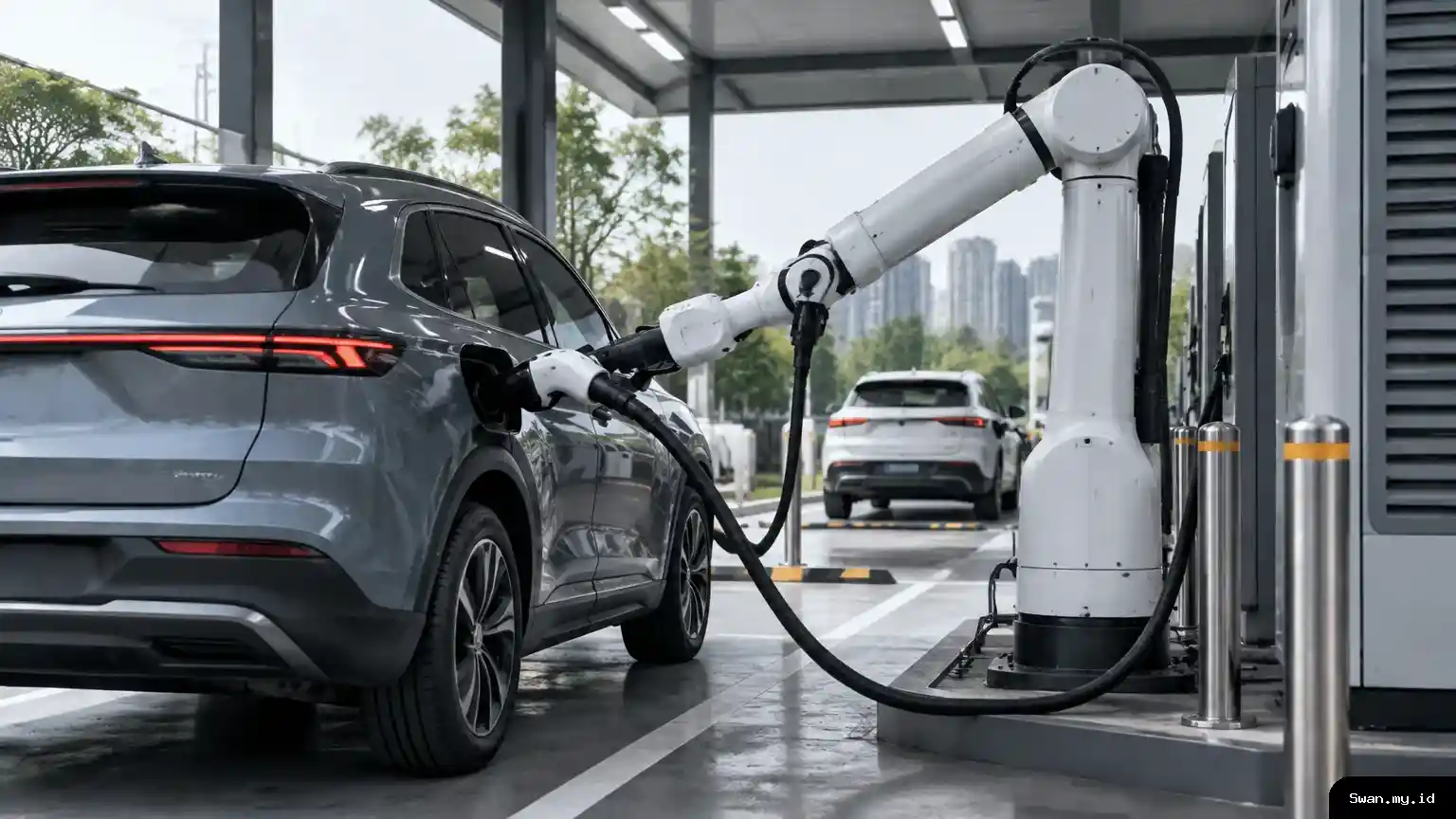
Swan.my.id - Chery’s Volt-Dragon charging network aims to make electric-vehicle stops shorter while giving cars a role in local energy systems. The company says its chargers can deliver up to 1.44 megawatts and add as much as 500 kilometres of driving range in five minutes. Those figures position Volt-Dragon among China’s ambitious megawatt-charging projects, although real-world results will depend on the vehicle and charging conditions.
Chery presented the system at its Global Innovation Conference. CarNewsChina reported on the announcement on October 24, 2026, including the company’s claim that a compatible battery can charge from 10% to 97% in six minutes and 50 seconds. The range figure and battery-charging time describe different measures, so they should not be treated as interchangeable performance guarantees.
Even so, the project addresses a familiar concern for drivers considering an EV: charging can take longer than refuelling a conventional car. Chery’s broader proposition goes beyond a powerful charger. It combines high-voltage hardware, automated cable handling and two-way energy flows in one planned charging ecosystem.
How the Chery Volt-Dragon charging network is designed
Volt-Dragon is built around very high charging output, supported by vehicle electrical platforms rated from 800 volts to above 1,000 volts. Higher-voltage architecture can help move large amounts of energy quickly. However, a charger’s maximum rating alone does not determine how fast a battery fills.
The vehicle must support the system, and the battery must be able to accept the incoming power. Temperature, battery condition and the circumstances of a charging session can also affect results. Therefore, Chery’s headline figures should be understood as company claims for compatible equipment, not a promise that every EV will gain the same range in five minutes.
Chery says the system can charge a battery from 10% to 97% in six minutes and 50 seconds. That is close to, but slower than, the 10%-to-98% time claimed for CATL’s third-generation Shenxing battery: six minutes and 27 seconds. Meanwhile, charging technologies from BYD, Huawei and Geely are described as taking about eight to nine minutes over a similar range.
These comparisons show how quickly the competition is developing, but they do not establish identical testing conditions across companies. Battery chemistry, vehicle design and charging protocols all matter. For drivers, the practical question will be whether the vehicle and station can sustain high charging power through a useful portion of the session.
Cooling, efficiency and hands-free charging
High power also brings a heat-management challenge. Volt-Dragon uses immersion liquid cooling to manage heat produced during high-capacity charging. Chery also says its latest-generation silicon carbide components help the system reach grid-to-plug efficiency of up to 96.5%.
That efficiency figure describes the share of energy transferred from the grid to the charging plug, according to the company’s presentation. It highlights that fast charging involves more than simply increasing output: electrical conversion and heat control also shape how effectively a station operates. The supplied information does not provide further test conditions for the figure.
Chery has also focused on the physical experience of handling the equipment. The company says the cable and connector together weigh two kilograms and produce operating noise below 50 decibels A-weighted. Those design details could make connecting a charger less cumbersome, though the system’s robotic option aims to remove manual connection altogether.
With the robotic arm, a driver can use a drive-through-style charging process without plugging in the cable by hand. The vehicle arrives at the station, and the automated equipment handles the connection. This approach may be useful for drivers who find heavy cables awkward, but its convenience will depend on how reliably the robot can serve compatible vehicles in everyday conditions.
V2G gives the charger a wider role
Volt-Dragon also supports vehicle-to-grid, or V2G, technology. In a V2G setup, a compatible EV can send some stored electricity back to a local power network rather than only drawing energy from it. That turns a parked vehicle into a potential energy resource as well as a transport tool.
Chery says owners could potentially benefit from supplying electricity when the network needs it. The actual opportunity would depend on the local grid, applicable arrangements and vehicle compatibility; the announcement does not specify payment terms. Still, two-way charging gives the infrastructure a purpose beyond reducing the time drivers spend waiting.
The company links the wider project with CheryMind, its large language model. Chery describes the AI system as supporting automotive development, including robotaxis, Level 4 autonomous driving and charging-network optimisation. The connection suggests that Chery sees charging as part of a broader mobility and energy ecosystem, rather than a standalone product.
Expansion plans and the challenge of scale
Chery has begun commercialising Volt-Dragon, with 100 stations opened across 10 major Chinese cities. It plans to announce a second expansion phase before the end of 2026. These early deployments provide a starting point for a network that the company ultimately wants to take beyond China.
By 2029, Chery targets more than 20,000 Volt-Dragon stations worldwide, with V2G capability. Reaching that goal would require substantial infrastructure growth, along with vehicles that can make effective use of the system. The announcement does not set out a country-by-country rollout schedule or explain how the company will deliver the full target.
For now, the network’s significance rests on how its parts work together: megawatt-scale charging, high-voltage vehicle platforms, cooling, robotic connection and energy export. If compatible cars can repeatedly achieve the advertised charging performance, the system could narrow one practical gap between EV charging and conventional refuelling. Yet station availability, vehicle compatibility and real-world charging conditions will determine whether that promise translates into a routine experience for drivers.
Chery is therefore pursuing two related goals: making charging stops faster and building infrastructure that can exchange power with the grid. The first depends on the charging curve and the car attached to the station; the second depends on V2G-ready vehicles and local energy arrangements. As the rollout proceeds, those details will matter as much as the headline power rating.
