

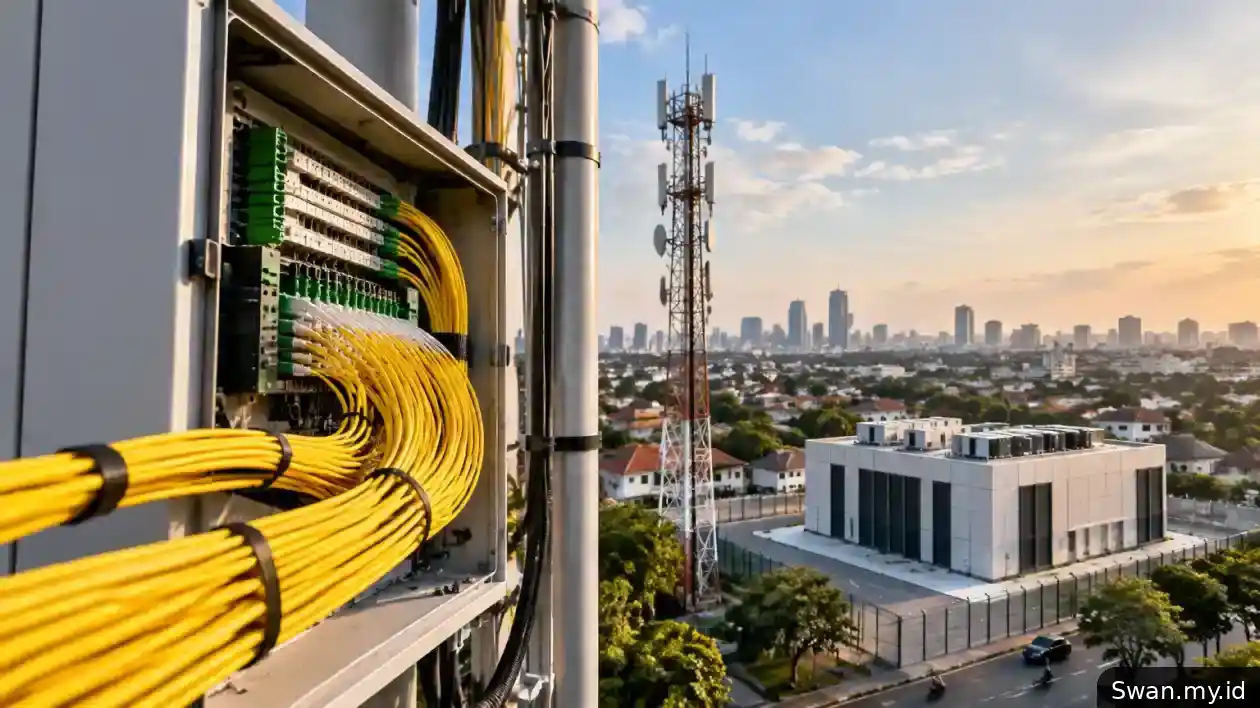
Swan.my.id - Indonesia fiber optic networks stretch across cities, connect mobile towers and data centers, and carry internet traffic to homes and businesses. Several publicly listed companies disclose networks measured in tens or even hundreds of thousands of kilometers. However, those figures do not all describe the same kind of infrastructure.
Some companies report backbone routes, while others include access networks or assets operated through subsidiaries. Reporting periods and measurement methods also vary. As a result, a longer published figure does not automatically mean a company has more customer connections or a larger network on a like-for-like basis.
Large networks, different reporting periods
PT Telkom Indonesia (Persero) Tbk (TLKM) reported 211,121 kilometers of backbone network in the first half of 2026. That total comprises 115,921 kilometers of domestic routes and 95,200 kilometers of international routes.
Those components show why the scope of a figure matters. Telkom’s total includes both domestic and international backbone infrastructure, rather than only cables linking homes to local services. Therefore, comparisons with a company reporting access lines or a national asset footprint need careful qualification.
PT XLSMART Telecom Sejahtera Tbk (EXCL) has a separate historical figure. XL Axiata reported 195,000 kilometers of fiber-optic cable in its 2024 annual report, before its merger into XLSMART. That number describes XL Axiata’s earlier reporting and should not be treated as XLSMART’s post-merger network total.
PT Ekamas Mora Republik Tbk (MORA) lists more than 183,000 kilometers of fiber-optic network on its official website. Its figure is not presented with the same period details as the first-half 2026 figures. Meanwhile, PT Sarana Menara Nusantara Tbk (TOWR) reported a national fiber asset footprint of approximately 182,600 kilometers for the first half of 2026.
- TLKM: 211,121 km of backbone, including domestic and international routes, in H1 2026.
- EXCL: 195,000 km reported by XL Axiata in 2024, before the merger.
- MORA: More than 183,000 km listed on the company website.
- TOWR: Approximately 182,600 km of national fiber assets in H1 2026.
These figures identify a number of large disclosed networks, but they do not create a complete, directly comparable league table. In particular, the dates and network definitions differ. Readers should check both the reported distance and the type of infrastructure behind it.
FiberStar and other network operators
Fiber infrastructure also sits within investment and infrastructure groups, not just telecom operators. DNET, through PT Mega Akses Persada, operates under the FiberStar brand. The company recorded 63,758 kilometers of deployed fiber-optic network at the end of 2025, supporting high-speed internet services.
DATA and BALI also disclose fiber-network activities. For BALI, the reported 8,839 kilometers appears specifically within its tower and telecommunications infrastructure segment. Consequently, that distance should not be assumed to represent every network category across the group.
These examples illustrate how corporate structure can affect reported totals. A listed parent may own an operating subsidiary, hold an interest in a venture, or disclose only one business segment. The network figure may therefore relate to an operating company or a defined segment rather than every asset associated with the listed group.
What fiber networks connect
Fiber-optic cables carry internet and data traffic over long distances. They can link cities, connect mobile base stations to wider networks, serve corporate customers, and provide access to homes. Yet these functions describe different parts of a network, from major routes to the final connection serving a building.
TOWR says its infrastructure supports fiber-to-the-tower (FTTT), fiber-to-the-home (FTTH), and connectivity services. RAIA Grid also supports network needs, including FTTH and links between data centers. Thus, fiber can serve both everyday broadband access and connections between facilities that handle large volumes of data.
Even so, a company’s total fiber length is not the same as the length of cable connected to residential customers. Backbone routes may span long distances, while access networks branch toward towers, businesses, or homes. A single reported total can combine infrastructure with different functions and users.
Physical assets and billable network length
Companies may also distinguish the physical network they own from the length used to generate revenue. TOWR reported 234,665 kilometers of revenue-generating FTTT, compared with approximately 182,600 kilometers of national fiber assets. Those numbers refer to different measures, so they should not be read as two competing estimates of an identical asset base.
Mitratel makes a similar distinction in its first-half 2026 disclosure. It reported 59,239 kilometers of physical fiber assets and a billable length of 74,779 kilometers. Billable length measures network capacity or connections charged to customers; it does not necessarily describe the physical distance of cable owned.
Another distinction appears in LINK’s reporting. The company recorded 33,861 kilometers of fiber-optic network separately from 16,346 kilometers of hybrid fiber-coaxial, or HFC, network. HFC combines fiber-optic infrastructure with coaxial cable, so adding the two figures without labeling them would blur the difference between network technologies.
How to compare company figures
A useful comparison starts by asking what each distance includes. Is it a backbone, a national asset footprint, a deployed network, an access network, or a revenue-generating service? The answer determines whether two figures can be compared directly.
Next, check the reporting period and corporate scope. A 2024 figure from XL Axiata predates the formation of XLSMART, while a first-half 2026 disclosure captures a later period. Likewise, a subsidiary’s network may not be identical to the total footprint of its listed parent.
Finally, keep physical kilometers separate from commercial measures such as billable length. Together, these distinctions make the reported figures more useful: they show the scale and variety of fiber infrastructure supporting Indonesia’s digital services, without suggesting that every company measures its network in the same way.
