

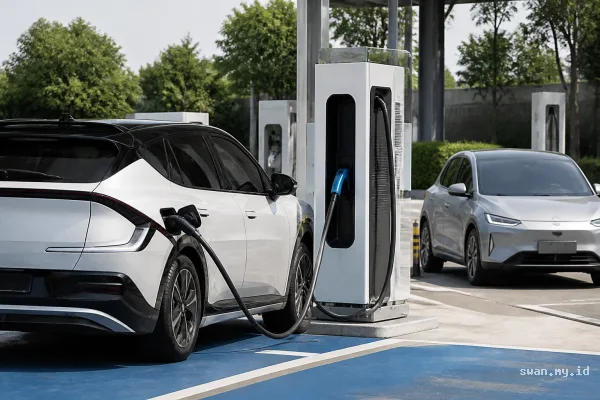
Swan.my.id - Jakarta, Indonesia’s electric-car fleet has reached 223,100 units, while roughly 5,030 chargers are available across the country. The gap is drawing attention to access at public charging stations, where queues are increasingly encountered, particularly during intercity travel.
The vehicle figure comes from the Ministry of Industry, while the charger count is based on information in the PLN Mobile application. A rough comparison puts the ratio at about 44 electric cars for every charger.
That comparison does not describe how many vehicles use each charger at a given time. However, it highlights the pressure that can arise as the number of electric cars grows faster than the availability of charging infrastructure. EV community member Alfred says differences in vehicle charging capability can also contribute to queues.
EV charging stations face pressure as the fleet grows
The rise in electric-car numbers has not been matched by an even distribution of charging infrastructure, according to the information cited in the report. With approximately 5,030 chargers across Indonesia, drivers may encounter queues at public charging stations, especially when travelling between cities.
The figures offer a broad snapshot rather than a measure of conditions at each station. The national ratio of about 44 cars per charger is a simple calculation from the two totals, and it does not show the location, availability or use of individual chargers.
Even so, the growing fleet and limited charger count help explain why access has become a concern for some users. Alfred, an EV Holic community member and BYD M6 owner, said that taking an electric car out of town was becoming less appealing as more affordable electric cars entered the market.
His comments point to another part of the issue: the amount of power a vehicle can accept. A high-capacity charger may offer more power than a particular car can use, so the charger’s maximum output alone does not determine how quickly that vehicle can charge.
Differences in charging power can shape queues
Alfred said some owners of electric cars with lower charging limits join queues for ultra-fast chargers rated at 160 kW to 350 kW. In his view, this can leave vehicles with longer charging times competing for the same equipment as cars that can make greater use of its capacity.
He cited the Atto as an example, saying its maximum charging power is 88 kW. That figure is well below the capacity of the 160 kW or 350 kW machines he mentioned.
The comparison concerns a vehicle’s maximum charging input and a charger’s rated output. It does not mean that every car can draw the full power shown on a charger. As Alfred’s example suggests, a car’s own limit matters when drivers choose which charging equipment to use.
When vehicles with different charging capabilities wait for the same high-powered equipment, drivers may not receive the same benefit from that charger. Alfred linked this mismatch to competition at stations and said the situation could make longer trips less attractive for some electric-car owners.
His account describes a concern raised by a community member and user; it does not establish that every queue has the same cause. The available figures also do not specify how often queues occur or how long drivers wait. Still, the difference between charger output and vehicle limits is central to Alfred’s explanation.
Alfred proposes tariffs based on charger power
To address the issue, Alfred proposed that PLN differentiate tariffs according to the power of the charging equipment. He suggested that charging on machines rated at 160 kW or above should have a different tariff from charging on lower-powered machines.
Alfred described the proposal as a way to distinguish charging that takes longer from charging that takes less time. He also argued that a different tariff could help address competition for high-powered equipment while the number of SPKLU units remains limited.
The proposal is Alfred’s view. The information available does not set out a tariff plan from PLN or confirm that a power-based pricing system is being introduced. It also does not provide tariff amounts or explain how such a system would work in practice.
Separately, Alfred welcomed steps to regulate vehicles that remain parked after their batteries have reached full charge. He pointed to a fine scheme for cars that continue occupying a charging space after charging is complete.
That measure addresses the use of a charger after a vehicle has finished charging, while Alfred’s tariff proposal focuses on differences in charger power and charging time. Both concerns relate to how drivers share public charging facilities, but they address different stages of the process.
Access depends on more than charger capacity
The reported figures show a growing electric-car population alongside a smaller count of chargers. Alfred’s comments add a user perspective: matching vehicle capabilities with charger capacity may matter when several drivers seek access to the same equipment.
However, the figures alone cannot show how well the charging network serves drivers in a particular area. They provide neither a station-by-station breakdown nor details about local demand. The reported ratio should therefore be read as a rough national comparison, not a prediction of waiting times.
For now, the discussion centres on two issues raised in the report: the availability of charging equipment and the way drivers use chargers with different power ratings. Alfred’s proposal for differentiated tariffs remains a suggestion, while the fine scheme for vehicles left after charging has finished is among the measures he welcomed.
As electric-car numbers rise, these concerns are likely to remain part of the conversation around public charging access. The data and comments underscore the need to consider both the number of chargers and the differences between vehicle charging limits and charger capacity, without treating one factor as the sole cause of every queue.
