

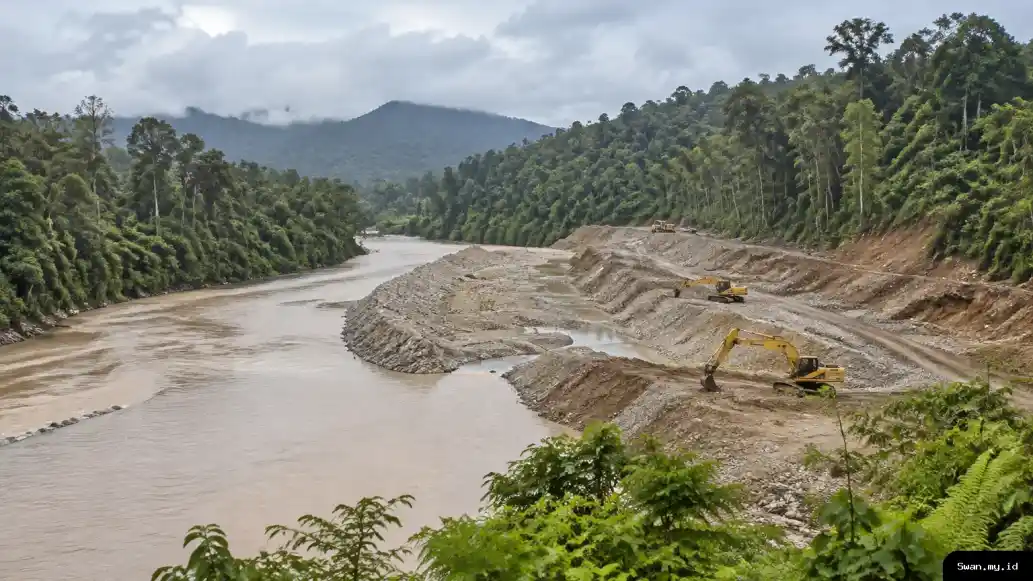
Swan.my.id - The Nabire gold mine in Papua Tengah is entering a new phase after the government revoked PT Kristalin Eka Lestari’s operating permit and handed the concession to state-owned PT Aneka Tambang, or Antam. The move followed government findings of forest-use and permit violations, but it has also raised a wider question: will a change of operator improve conditions for local people?
Environmental advocates say the transfer could keep extraction going without addressing its effects on communities and rivers. The government, meanwhile, says Antam must protect the environment and consider residents’ interests. Those promises will matter in Makimi, where industrial mining has already reshaped the debate over land, livelihoods and development.
Why the government revoked the mining permit
On 22 October 2026, senior officials from the Forest Area Enforcement Task Force, known as Satgas PKH, announced the takeover at the mining site in Makimi District, Nabire Regency. The task force operates under a presidential regulation signed in 2025.
Attorney General Sanitiar Burhanuddin said a joint field inspection found mining inside production forest areas without the required permission. He said the affected area covered 375 hectares: about 270 hectares inside the company’s mining permit area and another 105 hectares beyond it.
The government also cited the company’s failure to provide a reclamation guarantee and unresolved work-plan and budget documents. Sanitiar said the revoked permit meant Kristalin Eka Lestari no longer had the basis to mine. He added that the company must address environmental restoration, royalties and wages or severance owed to workers.
The company disputes the government’s account. Fandi Denisatria, a lawyer representing Kristalin Eka Lestari, said the company had been seeking a forest-use permit since 2024. He acknowledged that approval had not yet been issued, but argued that the application was being processed.
Fandi also said the company had held approval for a work plan covering 2024 to 2026. He argued that new rules requiring annual approval had complicated the process. However, the company appeared on an Energy and Mineral Resources Ministry list of 106 mining firms that had not secured approval for their 2026 plans. The ministry’s director general of minerals and coal, Tri Winarno, said companies without an approved plan could not legally mine.
A long-running dispute over gold in Makimi
Kristalin Eka Lestari entered Nabire after years of exploration and later received an operating permit. The company described its project as Papua’s second-largest gold mine after Freeport Indonesia’s operation in Mimika. Its activities have divided local opinion: some residents have supported the company, while others have blamed mining for environmental damage.
The wider gold industry in Nabire is not new. Academic research published in 2007 described gold mining across five districts, including Makimi, with much activity concentrated around rivers. Gold in the area is largely alluvial, unlike the deposits mined in the mountains around Mimika.
Small-scale miners have worked in Nabire for decades, alongside companies that have pursued exploration or extraction. A 2007 study by the government’s geological research centre recorded tens of thousands of people working in small-scale mining across the region. That history makes the transition to Antam part of a larger challenge: regulating mining while protecting the communities and waterways connected to it.
Residents describe flooding and lost livelihoods
For people living near the Kristalin Eka Lestari site, the impact of mining is not only a question of permits. In interviews in December 2025, residents of Lagari Jaya village described muddy river water and more frequent flooding after mining activity moved to a new area.
A resident named Luther said flooding had become much more common after operations shifted towards the eastern side of the village. He described floods occurring several times a month, sometimes after relatively light rain. The account reflects residents’ concerns, though the company’s public-relations representative rejected their claims and said the firm met its obligations, including those related to waste.
Another resident, Serly, acknowledged that the company had provided food, financial assistance and support for community projects. She nevertheless said those contributions could not compensate for environmental losses. That contrast—between short-term assistance and lasting changes to land and water—lies at the heart of the local debate.
Panah Papua environmental advocate Sulfianto Alias said the mining had not brought broad prosperity to Makimi or Nabire. In his view, benefits had gone mainly to influential individuals, while the wider community received little. He argued that changing the company would not solve the problem if mining continued without environmental recovery and meaningful local participation.
What Antam’s role could mean for Nabire
The government has assigned the concession to Antam, a state-owned mining company that already holds several mineral concessions in Papua. The transfer makes Antam the next planned operator, but it does not by itself answer how past damage will be repaired or how local people will benefit from future activity.
Sanitiar said Antam would put community interests and environmental protection ahead of profit alone. He also said the government planned to create rules that would allow local residents to mine legally for their livelihoods, while preventing outside investors from using them as a front for larger operations.
Frits Boray, head of the Central Papua Energy and Mineral Resources Office, said Antam must avoid the mistakes of previous companies and pay attention to Indigenous communities. Those expectations will be tested through practical decisions: how the company manages its work, what it discloses and whether residents have a meaningful role in decisions affecting their land.
Sulfianto has called for damaged ecosystems to be restored before officials focus on further extraction. He argues that lasting livelihoods should come from economic activity that can renew the environment rather than deplete it. The contrast matters in a region where gold mining has lasted for decades, yet residents continue to raise concerns about poverty and the distribution of benefits.
For now, the handover marks a change in who holds the concession, not proof that the underlying disputes have ended. The next phase will show whether Antam’s involvement brings stronger oversight, environmental repair and tangible gains for Makimi’s communities—or simply keeps mining on the same path under a new operator.
