

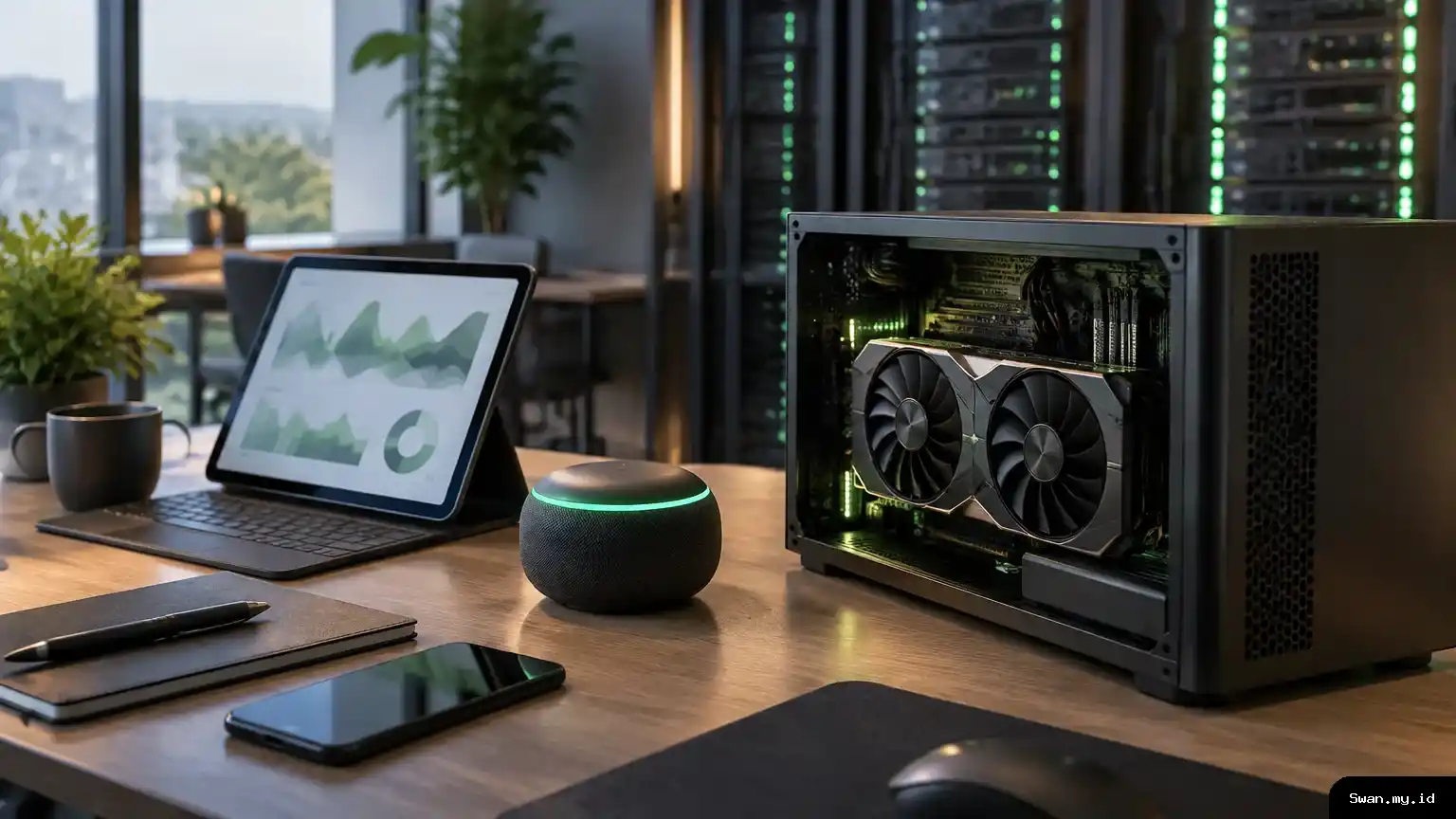
Swan.my.id - Nvidia Nemotron 3.5 AI models are designed to put agent capabilities on a wider range of hardware, from data-center systems to personal computers and smart devices. Nvidia introduced three open-weight models on October 15, 2026, each aimed at a different kind of workload. The lineup includes a large multimodal system for complex tasks, a model for local PC use and a compact option for devices with limited computing resources.
This approach reflects a practical challenge for AI developers: one model may not suit every job or machine. A long business workflow can demand broad reasoning and visual understanding, while a voice assistant needs to respond on a smaller device. Nvidia’s three releases offer developers distinct starting points for building those agent experiences.
Nvidia Nemotron 3.5 AI models target different workloads
The largest release, Nemotron 3.5 Super VL, has 120 billion parameters and supports multimodal tasks. Nvidia developed it with the Nemotron Coalition, a group of model developers and AI laboratories focused on open models. The company designed it to follow instructions, use tools, interpret visual information and work through multi-stage business processes.
That combination could help an agent handle documents and other visual material rather than relying only on plain text. For example, the model can process web pages, extract text from documents, interpret tables and charts, and work with PDF files. As a result, companies could use it to review financial records, examine credit agreements or assist with research and document checks during business transactions.
Nvidia says Super VL’s reasoning performance is comparable to that of its largest reasoning models, while using about one-fifth as many parameters as the comparison model. The company also claims it can produce outputs nearly five times faster than other models in its class. Nvidia reports that training covered about 26 trillion tokens across initial and later training stages.
Businesses can also adapt the model using their own data, tools, policies and workflows. That flexibility matters when an agent must follow company-specific procedures. However, teams still need to decide which internal information and tools to connect, and how to fit the model into their existing systems.
Local PC AI gets a 24GB option
Nemotron 3.5 Bolt 74B-A9B is aimed at developers who want agents to run directly on a computer instead of sending every task to a cloud service. Although it has 74 billion parameters, the model uses about 9 billion for each task. Nvidia uses two-bit quantization to reduce memory demands, allowing the model to run with 24GB of memory.
The company lists systems with Nvidia GeForce RTX GPUs, RTX PRO workstations, DGX Spark and DGX Station among the platforms for this model. Potential tasks include searching the web, writing code and debugging software. These uses place the model closer to a personal or workplace computing environment than a remote-only AI service.
Running tasks locally can also limit the need to send related data to a third-party cloud provider. That may appeal to organizations handling sensitive or internal information. Still, local operation does not by itself guarantee privacy; users must also consider how their devices, software and connected services manage data.
The model’s parameter count may sound large for a PC, but its stated 24GB memory requirement reflects the effect of its compressed format. In practice, developers will need compatible hardware and enough available memory to run it alongside other applications. The specification gives teams a clearer basis for judging whether local deployment fits their setup.
A smaller model for voice assistants and smart devices
Nemotron 3.5 Bolt E4B is the compact member of the lineup, with a 4GB memory requirement. Nvidia designed it for conversational agents and devices with limited computing capacity. Its potential settings include smart accessories, household devices, vehicle systems, customer-service interfaces and voice assistants.
Nvidia says developers can use the model to create local voice assistants, interactive characters and smart interfaces that adjust experiences to user needs. Because processing can happen on the device, these applications need not rely on a cloud connection for every interaction. That design can support more direct responses, although the actual experience will depend on the device and the application built around the model.
The company lists Nvidia GeForce RTX, Jetson and RTX/DGX Spark systems as intended platforms for Bolt E4B. Nvidia scheduled its release for October 23, 2026. Super VL and Bolt 74B-A9B, meanwhile, are already available through Hugging Face.
Open weights give developers room to adapt
All three models belong to Nvidia’s open-weight AI family. Open weights allow developers to download a model’s weights, run it on their own infrastructure and adapt it for particular needs. This differs from relying solely on a closed service, where access and customization depend more heavily on the provider’s platform.
The three models do not offer identical capabilities, and their hardware requirements vary considerably. Super VL addresses more involved multimodal and business workflows; Bolt 74B-A9B brings agent tasks to suitable local computers; and Bolt E4B targets smaller, resource-constrained devices. Developers can therefore choose based on the task, available hardware and whether they want processing to stay local.
For organizations, that choice also shapes deployment decisions. A document-heavy workflow may favor the larger multimodal model, while an offline assistant or device interface may benefit from a smaller local model. Nvidia’s release expands the options, but teams still need to evaluate performance, memory availability and integration requirements for each use case.
