
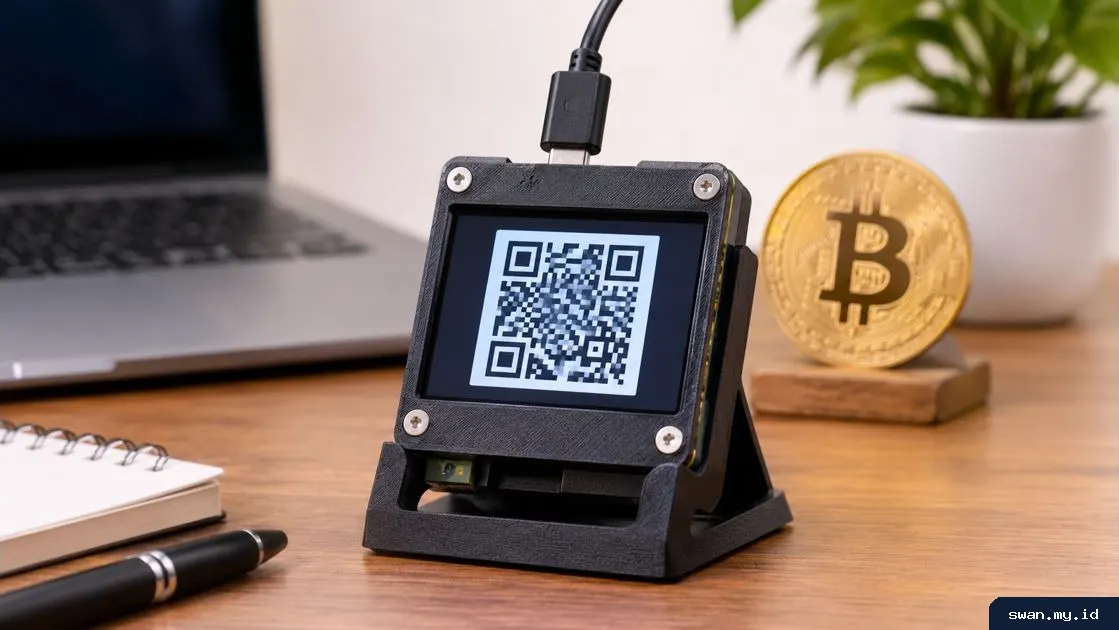
Ilustrasi: Stateless Bitcoin Security
Swan.my.id - Bitcoin Security, the SeedSigner review highlights an alternative approach to protecting Bitcoin private keys. Instead of permanently storing a recovery seed, SeedSigner loads sensitive information into temporary memory when users need to sign transactions.
This design creates a different security model from devices that retain wallet information for repeated use. Once the device loses power, its temporary secret data disappears. Consequently, users must load their seed again during their next signing session.
SeedSigner also uses QR codes to communicate with a separate wallet application. This arrangement separates transaction preparation, offline signing, and transaction broadcasting. However, the design also places considerable responsibility on users who must protect their backups and verify every transaction carefully.
This review examines SeedSigner's documented features, operating process, advantages, and limitations. It draws on official project documentation and relevant technical standards rather than hands-on device testing.
How Does SeedSigner Work?
SeedSigner functions as an offline Bitcoin transaction signing device. It does not independently handle the entire wallet management process. Instead, a separate wallet application prepares the transaction before transferring its information to SeedSigner.
The process relies on QR codes and a transaction format called Partially Signed Bitcoin Transaction, or PSBT. This format allows wallet applications and signing devices to exchange transaction information before a Bitcoin transaction receives its required signatures.
1. Loading the Seed for Each Session
Users begin by entering their seed phrase or scanning a SeedQR. SeedQR represents recovery information as a QR code, making the loading process more convenient than manually entering every word.
However, SeedSigner does not permanently retain the secret seed in its normal operating design. The device keeps sensitive information in temporary memory while powered on. Once power stops, users must load the seed again.
This approach reduces the amount of sensitive information that remains on the device after shutdown. Nevertheless, users must keep their recovery backups accessible and secure. Therefore, backup management becomes an essential part of everyday operation.
2. Preparing and Reviewing Bitcoin Transactions
A wallet coordinator prepares the PSBT and transfers its information to SeedSigner through a QR code. The device then displays relevant transaction details for the user to review before signing.
The project documentation lists compatibility with several wallet applications, including Sparrow, Nunchuk, BlueWallet, and Specter Desktop.
During this stage, users should carefully examine the following details:
- Recipient address: Confirm that the destination matches the intended recipient.
- Transaction amount: Check the amount of Bitcoin being transferred.
- Transaction fee: Review the fee before approving the transaction.
- Change output: Check that the remaining Bitcoin returns to the correct wallet address.
These checks matter because an offline signing device cannot determine whether a payment recipient deserves the user's trust. The user must understand and approve the transaction details.
3. Returning the Signed Transaction
After approval, SeedSigner returns the signed transaction information through another QR code. The wallet coordinator receives the result and handles the remaining transaction process, including broadcasting it to the Bitcoin network.
This separation allows SeedSigner to perform signing without requiring a direct network connection. However, offline operation does not eliminate the need to inspect transaction data. Users still need to verify the information moving between the device and wallet application.
SeedSigner Review: Main Advantages and Limitations
1. No Permanent Seed Storage
One of SeedSigner's defining features is its stateless design. The device does not normally retain the user's seed permanently. Instead, it loads the secret when needed and removes temporary information when power stops.
This reduces the risk of leaving sensitive seed information on the device after use. However, it does not protect a recovery phrase that someone has already copied or photographed.
In other words, the security benefit depends on protecting the original backup. A device that forgets its seed cannot make an exposed backup safe again.
2. Builds on Common Hardware Components
SeedSigner's official website presents a design based on the Raspberry Pi Zero version 1.3. The project also describes a possible component cost below US$50.
However, this figure represents the project's stated estimate, not a guaranteed price for a complete device in Indonesia. Additional expenses may include a case, shipping, tools, and other assembly requirements.
The Raspberry Pi Zero version 1.3 does not include Wi-Fi or Bluetooth. Nevertheless, other hardware variants may include wireless components. Therefore, users should identify their exact hardware model and follow the project's configuration instructions when building an air-gapped device.
This hardware approach offers flexibility for people who understand basic electronics and assembly. On the other hand, users without technical experience may find troubleshooting and configuration more challenging.
3. Open-Source Software and Reproducible Builds
SeedSigner provides publicly available source code and reproducible builds. This allows interested users to examine the software and verify whether a build matches the project's published version.
However, open-source availability does not automatically guarantee that every installation is secure. Most users still need to rely on the project's official release process and verification instructions.
The documentation explains how to check software signatures and hashes. These checks help users identify files that do not match the project's published releases. Nevertheless, successful verification does not prove that software contains no bugs or vulnerabilities.
Important SeedSigner Security Risks to Understand
1. Repeated Backup Handling
Because SeedSigner does not permanently store the seed, users must access their backup whenever they begin a new signing session. This creates a recurring operational responsibility.
Every time someone handles a recovery phrase, the surrounding environment matters. Other people, nearby cameras, and careless backup practices can expose sensitive information.
Some users may consider photographing their backup for convenience. However, creating digital copies can undermine the security benefits of keeping the seed offline and private.
2. SeedQR Is Not an Ordinary Public QR Code
SeedQR contains sensitive wallet recovery information. It is fundamentally different from a QR code that displays a public Bitcoin address.
Standard SeedQR and CompactSeedQR encode seed information rather than encrypting it. Therefore, anyone who obtains an unprotected copy may gain access to the secret information it contains.
The project documentation warns users against photographing SeedQR or storing it in digital media. Users should treat these codes as carefully as their written recovery phrases.
3. Air-Gapped Operation Does Not Guarantee Safe Transactions
An air-gapped configuration limits direct network communication with the signing device. However, this protection does not automatically prevent users from approving malicious transactions.
For example, a transaction can still send Bitcoin to an incorrect address if the user fails to notice the destination during review. Therefore, transaction verification remains essential even when the signing device stays offline.
Technical Details That SeedSigner Users Should Know
BIP39 Passphrases Can Create Different Wallets
One important detail concerns the relationship between a seed phrase and its optional BIP39 passphrase. Each passphrase produces a valid wallet seed. As a result, entering an incorrect passphrase may open a different wallet rather than trigger an obvious error.
A wallet that appears empty does not necessarily mean that the original Bitcoin has disappeared. Users should first check their passphrase and wallet configuration before assuming that their funds are inaccessible.
Do Not Create Seed Phrases from Favorite Words
A secure seed phrase should come from a proper entropy-generation process. BIP39 does not recommend choosing familiar words or creating a memorable sentence as a replacement for randomly generated wallet recovery information.
Predictable phrases can weaken wallet security. Moreover, using an offline device does not correct weaknesses in an improperly generated seed.
Test Wallet Recovery Before Relying on It
Successfully creating a wallet and receiving Bitcoin does not prove that its backup will restore the same wallet later. Recovery also depends on remembering the correct configuration.
Depending on the wallet setup, users may need additional information, including the address type, derivation path, and multisignature configuration.
Therefore, testing the recovery process in a safe environment is an important precaution. It can help identify missing information before users depend on the backup to recover significant funds.
Is SeedSigner's Stateless Design Worth Considering?
The most important question is not simply whether SeedSigner removes its seed after shutdown. Users should also consider how this design changes their daily security habits.
The stateless approach reduces permanent secret storage on the device. However, it requires users to handle their recovery backups repeatedly. This creates a trade-off between reducing stored information and increasing operational responsibility.
A disciplined user may manage this process carefully. Meanwhile, someone who frequently rushes through transactions may look for shortcuts that introduce new security risks.
A practical SeedSigner security assessment should consider four important stages:
- Device preparation: Use the correct hardware configuration and verify the software installation.
- Backup handling: Protect seed phrases and SeedQR from unauthorized access or digital exposure.
- Transaction verification: Examine recipient addresses, amounts, fees, and change outputs before signing.
- Wallet recovery: Confirm that the backup and wallet configuration can restore the intended wallet.
Strong protection at one stage cannot compensate for careless practices at another. Consequently, users should evaluate the entire process rather than focus on a single security feature.
SeedSigner Software Development and Language Support
The project's release information provides another detail worth considering. As of October 15, 2026, the official SeedSigner release page listed version 0.8.7 as the latest release.
Its release notes included Indonesian interface support in beta status. However, interface language and seed phrase language are two different things.
The SeedQR documentation recommends using the English BIP39 wordlist because the format does not provide a mechanism to identify the language of the wordlist. Therefore, users should not assume that selecting an Indonesian interface automatically changes the seed phrase format.
Release information can change after publication. Users should check the project's official release information before installing or updating their devices.
Frequently Asked Questions About SeedSigner
Does Bitcoin disappear when SeedSigner shuts down?
No. Shutting down SeedSigner removes temporary secret information from the device's memory. Bitcoin remains recorded on the blockchain. Access depends on having the correct recovery information and wallet configuration.
Can SeedSigner sign Ethereum and ERC-20 transactions?
SeedSigner is designed for Bitcoin transaction signing. Users should not assume that it supports Ethereum or ERC-20 tokens simply because these networks also use cryptographic private keys.
Is SeedQR encrypted?
No. Standard SeedQR and CompactSeedQR encode seed information rather than encrypting it. Treat both formats as confidential recovery backups.
Why does my wallet appear empty after entering the correct seed phrase?
A different BIP39 passphrase can produce an entirely different wallet. An incompatible derivation path or wallet configuration may also explain the problem. Check these details before concluding that your Bitcoin has disappeared.
Does Indonesian interface support mean the seed phrase uses Indonesian words?
No. Interface translation does not determine the language of the seed wordlist. SeedQR documentation recommends the English BIP39 wordlist because the QR format does not identify the wordlist language automatically.
Is SeedSigner still being developed in 2026?
As of October 15, 2026, the official release page listed version 0.8.7 as the latest release. Its release notes included beta Indonesian interface support. However, users should check the official project page for newer releases and development updates.
Final Verdict: Who Should Consider SeedSigner?
SeedSigner offers a distinctive approach to Bitcoin security by separating transaction signing from permanent seed storage. Its stateless design, QR-based communication, and open-source software provide several features worth examining.
Nevertheless, these features come with responsibilities. Users must protect their recovery backups, verify software, understand transaction details, and test wallet recovery procedures.
For people comfortable with technical wallet management, SeedSigner may offer a useful alternative for controlling Bitcoin signing operations. However, users who want a simple experience without repeated backup handling may find its workflow demanding.
Ultimately, no single device can guarantee complete Bitcoin security. The quality of the hardware, software verification, backup protection, and user's operating habits all matter.
Author: AL
Disclaimer: Cryptocurrency transactions involve financial risks and may result in losses. Always conduct independent research before making investment decisions. This article provides general information for educational purposes only. It does not constitute financial or investment advice, an offer, or a recommendation to buy or sell any financial product. Readers remain responsible for their own decisions and should carefully assess the risks associated with digital assets.