

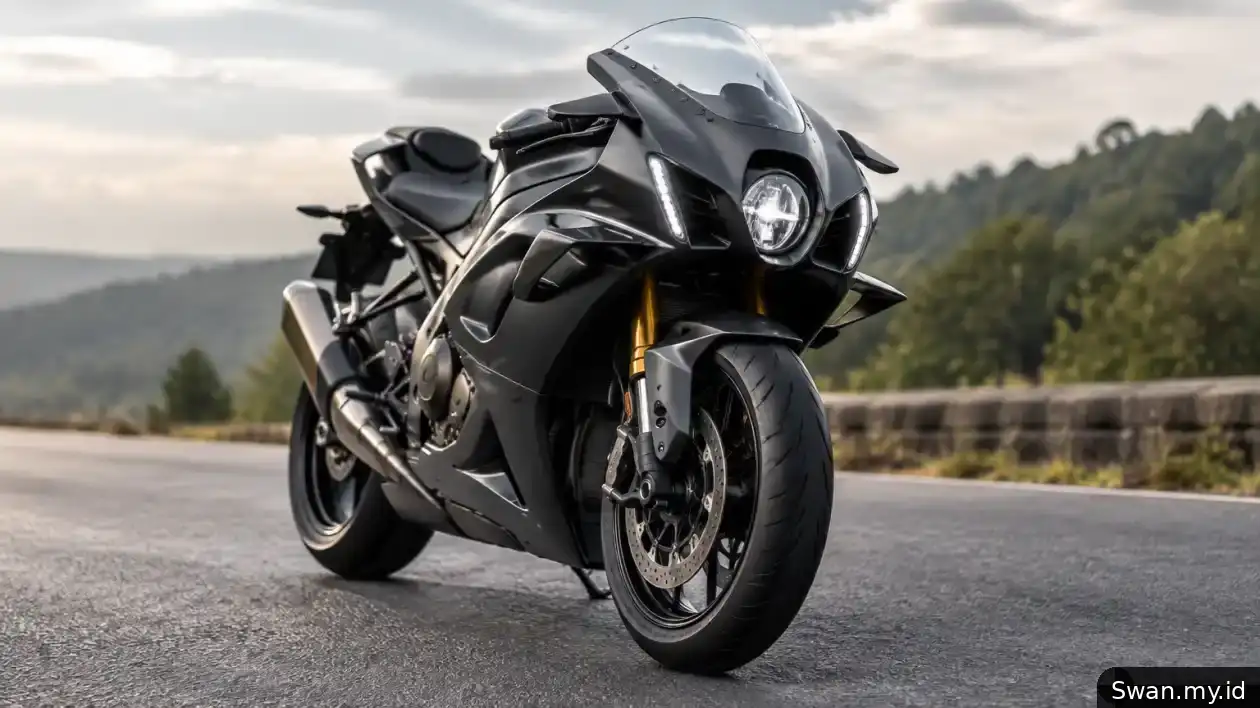
Swan.my.id - The Suzuki GSX-10R 2027 brings a new name and a distinct role to Suzuki’s sportbike range. Revealed at EICMA Milan 2026, it is a supersport model positioned between the GSX-8R and the GSX-R1000. Despite its styling, it is not a facelift of Suzuki’s flagship superbike.
Instead, the new motorcycle uses the GSX-S1000 as its technical starting point. Suzuki’s approach pairs a familiar 999cc engine platform with a sporty design and a focus on everyday usability. The result is aimed at riders who want strong performance and modern control systems without choosing the GSX-R1000’s more track-focused character.
Where the Suzuki GSX-10R 2027 fits
The GSX-10R adds a new option to the GSX family rather than replacing an existing model. Suzuki places it above the GSX-8R and below the GSX-R1000, giving the range a middle ground in both positioning and intent. Its supersport classification separates it from the more uncompromising superbike at the top of the line-up.
That distinction also reflects the bike’s mechanical basis. The GSX-S1000 platform uses an engine architecture different from the GSX-R1000’s, so buyers should not expect the new model to simply reproduce the flagship’s performance. Instead, Suzuki combines the established platform with revisions intended to suit the GSX-10R’s role.
The positioning suggests a motorcycle designed to balance sporting ability with manageable road use. Suzuki has not provided a price in the available details, so its eventual value relative to the other GSX models remains unknown.
Compact styling with GSX-R cues
The bodywork carries recognizable GSX-R family details, but the overall form remains compact. At the front, a single projector headlight sits centrally between two side air intakes. Vertical daytime running lights flank the arrangement and give the face a distinctive outline.
Small winglets add a contemporary sportbike detail without making the front look oversized. The restrained treatment helps preserve the motorcycle’s narrow, compact appearance. Together, the central lamp, side openings and clean body shape give the GSX-10R a clear visual identity without making it look like a direct copy of the GSX-R1000.
Its design therefore supports the model’s position in the family: sporty enough to look at home among Suzuki’s performance machines, yet distinct from the full superbike. The visual package also leaves the new model with a profile that suits a broader road-focused purpose.
999cc K5 engine produces 152 hp
Power comes from a 999cc K5-series engine shared with the GSX-S1000. Suzuki quotes a maximum output of 152 hp at 11,000 rpm and peak torque of 106 Nm at 9,250 rpm. Those figures place it below the latest GSX-R1000, which reaches 195 PS, and underline the difference between the two motorcycles.
Suzuki has revised internal engine components for the GSX-10R. Changes affect the cylinder head, cylinders and crankcase, with the stated aims of improving performance and durability. The revisions also address compatibility with future fuels containing higher proportions of biofuel.
The engine’s headline figures tell only part of the story. Its output, platform and revised internals help define the GSX-10R as a powerful supersport option rather than a replacement for Suzuki’s top-level superbike. How the changes feel in real-world riding will depend on the final production model and its calibration.
Road-focused ergonomics and electronics
Suzuki pairs the supersport bodywork with riding geometry influenced by superbikes. The handlebar, seat and footpeg positions shape the rider’s posture, while the seat height measures 810 millimetres. That is 15 millimetres lower than the GSX-R1000R, a difference that may make it easier for some riders to reach the ground.
Electronic assistance forms a major part of the package. Suzuki’s new Smart TLRS system works with a six-axis inertial measurement unit and brings together traction, lift, roll torque and slide control. Riders can choose from ten intervention levels, while the control system manages more than traction alone.
The equipment list also includes three engine performance modes, adjustable engine braking, cornering ABS and a two-way quickshifter. Launch control supports starts, while cruise control and an active speed limiter add further options for managing speed. Together, these systems give riders a range of adjustments for different conditions and preferences.
One additional feature is Brake Hold Control. When the motorcycle stops, the system can maintain pressure on the rear brake for up to 30 seconds, including on level ground or a slope. This function adds convenience at a standstill, alongside the broader electronic package focused on managing the bike’s response.
Connectivity, lighting and touring details
A colour TFT display provides the main instrument interface, with smartphone connectivity through Suzuki Ride Connect+. The motorcycle also receives a USB-C port for device charging. These additions bring practical equipment to a model whose styling and performance remain firmly within the sportbike category.
Suzuki’s new Ground Beacon lighting system uses the turn signals to project a light indication onto the ground. It adds a visual cue around the motorcycle, complementing the front lighting arrangement. Meanwhile, the 18-litre fuel tank gives the GSX-10R capacity for longer rides between stops, although actual range will depend on riding conditions.
Suzuki plans to begin sales in some European markets in early 2027. The company has not announced pricing in the available details, and there is no confirmation of an Indonesian launch. For now, the GSX-10R’s place in Suzuki’s range is clearer than its eventual availability beyond Europe.
With a 999cc engine, adjustable rider aids and a lower seat than the GSX-R1000R, the GSX-10R presents a different kind of performance choice. It sits between the GSX-8R and the flagship superbike, combining GSX-R-inspired styling with the GSX-S1000 platform. Its final appeal will depend on market pricing and how riders respond to that balance once sales begin.
